Talk to us

Good defense starts with learning how to move. Young basketball players need to get comfortable staying balanced, moving their feet, reacting to an opponent, and communicating with teammates. These habits take practice, but they do not require complicated defensive systems.
The best basketball defense drills build these skills gradually. Start with basic footwork, introduce one-on-one situations, and then help players understand how to defend as a team. The following basketball drills are suitable for youth players at different experience levels, with adjustments for age and ability.
What Are Basketball Defense Drills?
Basketball defense drills are practice exercises that teach players how to stop opponents from scoring. They develop defensive footwork, on-ball containment, closeouts, help defense, communication, and team positioning.
Some drills focus on individual movements, while others help players work together to defend drives, contest shots, secure rebounds, and stop fast breaks. For a broader collection of exercises covering both offense and defense, explore our guide to basketball drills for different skill levels.
Why Are Basketball Defense Drills Important?
Defense involves more than trying to steal the ball. Players must stay balanced, anticipate movement, make good decisions, and understand when to help a teammate.
Regular defensive practice helps players:
- Improve footwork: Learn to move laterally and change direction while maintaining balance.
- Stay in front of the ball: Practice containing drives without reaching unnecessarily.
- Contest shots under control: Close the distance to a shooter while remaining ready to react.
- Recognize help situations: Understand when to support a teammate and when to recover to their assignment.
- Communicate on the court: Call out the ball, screens, switches, and help responsibilities.
- Finish defensive possessions: Develop the habit of boxing out and securing the rebound after a missed shot.
Fundamental Basketball Defense Drills
Start with these exercises before moving into live one-on-one or team situations. The goal is to learn the movement correctly before adding speed and pressure.
1. Defensive Stance and Reaction Drill
Build a balanced defensive stance and help players react to simple visual or verbal cues.
How to do it:
- Have players spread out along the baseline with enough room to move.
- Ask them to bend their knees, lower their hips comfortably, keep their chest up, and hold their hands in an active position.
- Call out directions such as “left,” “right,” or “back.” Players move in the direction indicated while staying balanced.
- Occasionally call “freeze” to check their stance and foot placement.
- Increase the pace as players become more comfortable.
Reps: Three rounds of 20–30 seconds, with 20–30 seconds of rest.
Coaching focus: Players should stay balanced and ready to move rather than dropping so low that they cannot react comfortably.
Best for: Beginners and younger players learning defensive fundamentals.
2. Defensive Slide Drill
Teach players to move laterally without crossing their feet or losing their defensive position.
How to do it:
- Place two cones about 10–15 feet apart.
- Have the player start beside one cone in a defensive stance.
- On the coach’s signal, the player slides toward the second cone, pushing off the foot opposite the direction of movement.
- At the cone, the player changes direction under control and slides back.
- Repeat while keeping the chest facing forward and the feet separated.
Reps: Four to six trips between the cones, or three rounds of 20 seconds.
Coaching focus: Avoid crossing the feet during short lateral slides. If a player needs to turn and sprint during a longer recovery, teach that movement separately rather than forcing every movement to be a slide.
Best for: Beginners and players who need to improve their lateral footwork.
3. Defensive Mirror Drill
Help defenders react to an opponent’s movement instead of guessing where the player will go.
How to do it:
- Pair players of similar size and ability and have them face each other in a marked area.
- One player leads by moving from side to side.
- The defender mirrors the movement while maintaining a balanced stance.
- Once players understand the basic version, let the leader move forward, backward, and diagonally.
- Switch roles after 15–20 seconds.
Reps: Four rounds of 15–20 seconds per player.
Progression: Give the leader a basketball and allow them to dribble while the defender reacts.
Coaching focus: Encourage quick, controlled adjustments instead of reaching or leaning too far in one direction.
Best for: Youth players developing reaction time and defensive balance.
4. Closeout Drill
Teach players how to approach a shooter quickly and slow down under control.
A closeout occurs when a defender moves toward an offensive player who has received or is about to receive a pass. The defender needs to cover the distance without giving up an easy drive.
How to do it:
- Place an offensive player on the wing with a basketball. Position the defender a few steps away near the paint.
- Have a coach pass the ball to the offensive player.
- As the ball travels, the defender moves quickly toward the receiver.
- Near the player, the defender shortens their steps, gets balanced, and raises a hand to contest the shot.
- The defender finishes in a position that allows them to react if the offensive player drives.
Reps: Six to eight closeouts per player, alternating between the wings and corners.
Progression: Allow the offensive player to shoot, use a shot fake, or drive after the closeout.
Coaching focus: Arrive under control. A defender who rushes past the shooter or jumps at every fake can give up an easy scoring opportunity.
Best for: Beginners who understand the defensive stance and players learning perimeter defense.
Individual Basketball Defensive Drills
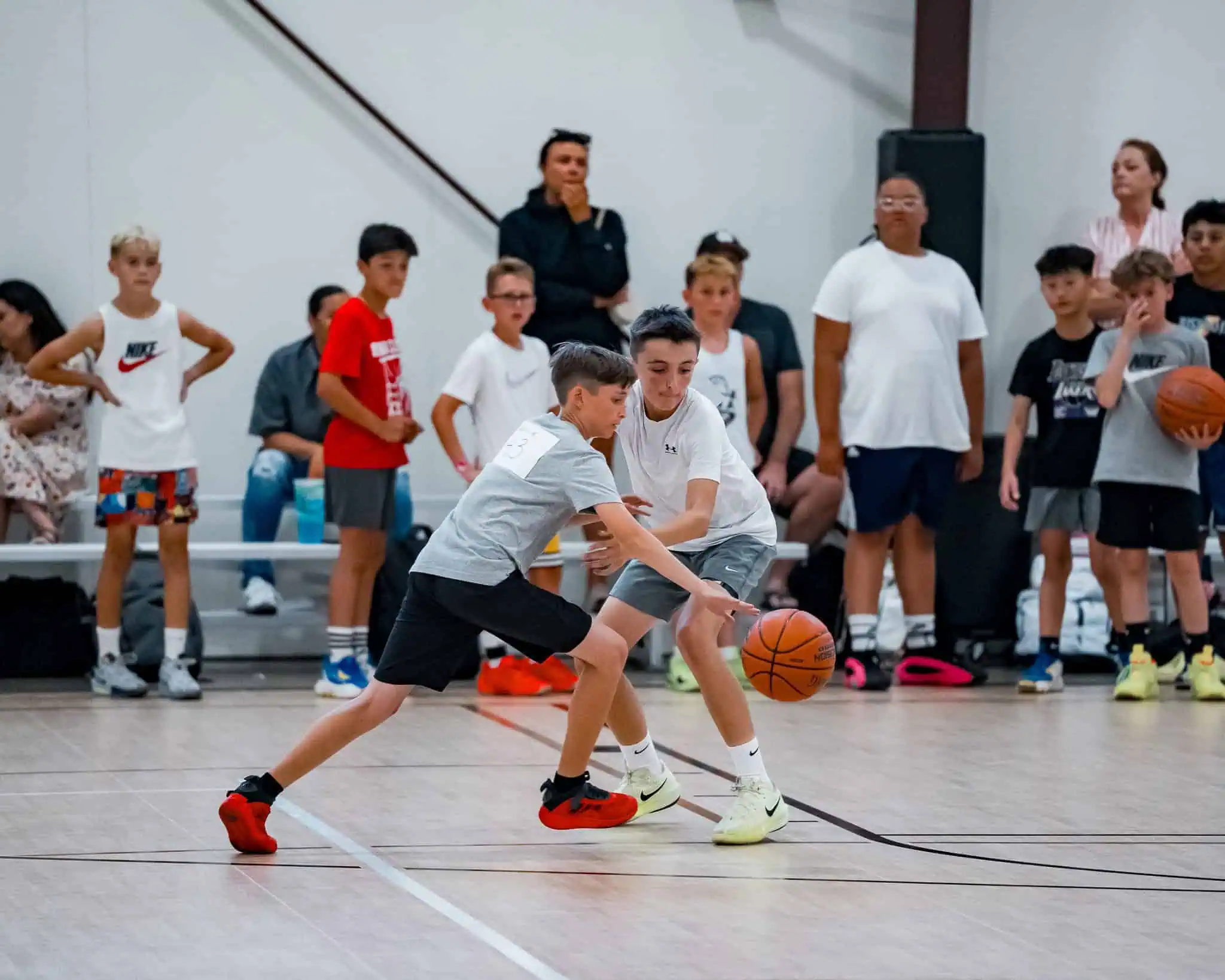
Once players can maintain their balance and move comfortably, introduce drills that involve a live offensive player.
5. One-on-One Containment Drill
Purpose: Help defenders stay between the ball-handler and the basket without relying on constant attempts to steal the ball.
How to do it:
- Place an offensive player with a basketball on the wing and a defender between them and the basket.
- Mark a target near the lane or paint for the offensive player to reach.
- On the coach’s signal, the offensive player tries to drive toward the target.
- The defender slides and adjusts their position to make the drive difficult.
- End the rep when the player reaches the target, scores, loses the ball, or the coach calls time.
- Switch roles and repeat from the other side.
Reps: Five to eight possessions per player.
Coaching focus: Reward the defender for staying in front, forcing a difficult attempt, or making the offense change direction. Do not reward reaching or unnecessary contact.
Best for: Players who have learned basic defensive footwork and are ready for one-on-one play.
6. Zigzag Defensive Drill
Give players practice defending changes of direction across a larger area of the court.
How to do it:
- Start an offensive player with a basketball near one sideline and place a defender in front.
- The offensive player dribbles diagonally toward the opposite sideline.
- The defender moves to stay in front and cut off the driving angle.
- At the sideline or a marked cone, the offensive player changes direction.
- The defender adjusts under control and continues to contain the drive.
- Continue across the court, then switch roles.
Reps: Two trips across half court for beginners. More experienced players can progress to longer trips.
Coaching focus: The defender should focus on the offensive player’s movement and maintain a position between the ball and the basket. Avoid turning the drill into a race.
Best for: Players who can already perform basic defensive slides.
7. Denial Defense Drill
Teach defenders how to make it harder for an opponent to receive a pass while staying aware of the basketball.
How to do it:
- Place a passer near the top of the key and an offensive player on the wing.
- Position the defender between the passer and the offensive player, using a stance that allows them to see both.
- Have the passer move the ball or make passes to different spots.
- The offensive player moves around the wing to get open.
- The defender adjusts their position to challenge the passing lane without losing sight of the player.
- Rotate the players after 10–15 seconds.
Reps: Four to six repetitions per player.
Progression: Allow the offensive player to make a backdoor cut if the defender overplays the passing lane.
Coaching focus: Denial positioning depends on the ball’s location and the team’s defensive rules. Players should not turn their backs on their assignment or automatically chase every pass.
Best for: Players learning off-ball defense and man-to-man principles.
Team Basketball Defense Drills
Individual defense is only part of the game. These drills teach players how to communicate, help teammates, and recover when the offense moves the ball.
8. Four-on-Four Shell Drill
Teach team positioning, closeouts, help-side awareness, and defensive rotations.
How to do it:
- Place four offensive players around the perimeter and match them with four defenders.
- Start with the offense passing the ball around the perimeter without dribbling.
- The defender guarding the ball applies pressure. The other defenders adjust their positions according to the ball’s location and their team’s defensive rules.
- On each pass, the new ball defender closes out under control while the others move into appropriate help or denial positions.
- Pause occasionally to check spacing and explain any positioning mistakes.
- When players understand the movement, allow cuts and controlled drives.
Reps: Spend about five minutes on the walkthrough, followed by several controlled possessions and a few live repetitions.
Coaching focus: All four defenders should adjust when the ball moves. Use clear calls such as “ball,” “help,” and “deny,” and teach the exact positioning principles your team uses.
Best for: Teams that understand individual defense and are ready to learn coordinated half-court defense.
9. Help-and-Recover Drill
Teach an off-ball defender to help stop a drive and then recover when the ball moves to another player.
How to do it:
- Set up three offensive players around the perimeter with three defenders.
- Give the ball to a player on the wing.
- The ball-handler drives toward the paint while their defender works to contain them.
- A nearby help defender moves into the driving path when appropriate and communicates the help.
- The offense passes to an open teammate.
- The helping defender recovers toward the receiver and closes out under control.
- Reset and repeat from the other side.
Reps: Four to six possessions per group.
Coaching focus: Help should be purposeful, not automatic. Players need to understand when to help and how their teammates will cover the space they leave.
Best for: Developing players who are learning team defense and recovery.
10. Three-on-Three Defensive Rotation Drill
Give players a simpler environment for practicing team defense against cuts, drives, and passes.
How to do it:
- Place three offensive players around the perimeter and match them with three defenders.
- Start with controlled passing so defenders can practice positioning.
- Allow the offense to drive once the defenders are ready.
- The on-ball defender works to contain the drive, while the other defenders help or adjust according to the team’s defensive rules.
- If the ball moves to another player, defenders recover and identify their assignments.
- Play until the offense scores, turns the ball over, or the defense secures a rebound.
Reps: Four to six possessions per group.
Progression: Limit the offense to one drive per possession before allowing unrestricted play.
Coaching focus: Look for communication, help positioning, and recovery rather than judging the drill only by whether the defense stops every basket.
Best for: Youth teams learning how individual defense connects to team rotations.
11. Defensive Stop Challenge
Encourage effort, communication, and finishing a defensive possession with a rebound.
How to do it:
- Divide the players into offensive and defensive groups.
- Set a target, such as five defensive stops.
- Give the offense a live possession.
- Award a stop when the defense forces a turnover or secures a defensive rebound after a missed shot.
- If the offense scores or gets an offensive rebound, the defense does not earn a stop.
- Switch roles after a set number of possessions and compare the results.
Reps: Eight to 12 possessions per group, adjusted for age and fatigue.
Progression: Require two or three consecutive stops to increase the challenge.
Coaching focus: A defensive possession is not complete just because the opponent misses. Players must also find their assignments, box out safely, and secure the ball.
Best for: Youth teams that need to build concentration and defensive accountability.
Full-Court Basketball Defense Drill
12. Transition Defense Drill
Teach players to react quickly when possession changes and protect the basket against a fast break.
How to do it:
- Start with a normal offensive possession.
- After a shot, turnover, or coach’s signal, change possession quickly.
- Players who were on offense turn and sprint back on defense.
- The closest defender works to slow down the ball-handler.
- Another defender protects the basket while the remaining players find the offensive players they need to cover.
- Let the play continue into half-court defense if the offense does not score in transition.
- Reset and repeat with different players.
Reps: Six to 10 transition possessions, with rest as needed.
Progression: Start with two defenders against one attacker or three defenders against two attackers before progressing to larger groups.
Coaching focus: Players should communicate, protect the basket, and identify the immediate threat. They should not all chase the ball and leave the rim unprotected.
Best for: Youth players and teams that need to improve their response when possession changes.
Common Basketball Defensive Mistakes to Avoid
Even when players practice regularly, a few habits can make defense harder than it needs to be.
- Standing too upright: Encourage players to maintain a comfortable, balanced stance that lets them move in either direction.
- Reaching instead of moving: Teach players to use their feet and positioning rather than lunging for steals.
- Crossing their feet on every slide: For short lateral slides, keep the feet separated. Teach turns and recovery sprints as separate movements when the situation calls for them.
- Watching only the ball: Players need to remain aware of the ball and their assignment, especially when they are away from the play.
- Helping without recovering: Help defense works best when players communicate and understand who will cover the space they leave.
- Forgetting to rebound: A missed shot is not the end of the possession until the defense secures the ball.
- Staying silent: Simple, timely calls help teammates react together and avoid confusion.
How to Choose the Right Basketball Defense Drills
You do not need to run all 12 drills in every practice. Choose a few based on what players need to learn.
- For beginners: Start with the defensive stance, defensive slides, and mirror drill.
- For players learning one-on-one defense: Add closeouts, containment, and the zigzag drill.
- For players learning team defense: Introduce denial, the shell drill, and help-and-recover.
- For teams preparing for games: Use three-on-three rotations, the defensive stop challenge, and transition defense.
Keep instructions short and focus on one or two coaching points at a time. As players become more comfortable, make the drills more game-like rather than simply asking them to move faster.
Build Better Basketball Skills at Valley Athletics
Becoming a more confident defender takes consistent practice, feedback, and opportunities to apply skills in real game situations. Young players can start with basic footwork and gradually work toward reading offensive movement and defending as part of a team.
Families in Fresno can learn more about training opportunities at the Valley Basketball Academy, where basketball programs include fundamental skill development, defensive techniques, and game situations. For more ideas to support your player’s progress, read our guide on how to improve in basketball.
Ready to Become a More Confident Defender?
FAQs
-
What are the best basketball defense drills for beginners?
Start with defensive stance and reaction drills, defensive slides, the mirror drill, and closeouts. These exercises help beginners learn balance, footwork, and how to react to an offensive player before progressing to live one-on-one defense.
-
How can I improve my defense in basketball?
Practice staying balanced, moving your feet, containing drives, and closing out under control. As you improve, work on help defense, communication, and securing rebounds. Ask a coach to help identify the habits you should focus on first.
-
What is the shell drill in basketball?
The shell drill is a team defensive exercise that teaches players how to adjust their positions as the ball moves. It can help teams practice closeouts, help-side positioning, communication, and defensive rotations.
-
What is the difference between man-to-man and zone defense?
In man-to-man defense, players are responsible for guarding specific opponents. In zone defense, players protect assigned areas of the court. Both approaches require communication and coordinated movement.
-
Can I practice basketball defense drills alone?
Yes. You can practice defensive stance, lateral footwork, and cone slides on your own. However, drills such as mirror work, one-on-one containment, and help-and-recover are more effective with a partner or team because they require you to react to other players.
-
How often should youth basketball players practice defense?
Defensive work can be included in regular team practices, with the time adjusted to the player’s age, experience, and overall workload. Even a focused 10–15-minute segment can provide useful repetition. Prioritize good technique, appropriate rest, and a mix of skills rather than repeating intense drills every day.