Talk to us

Basketball dribbling drills help players become more comfortable with the ball, improve their control, create space, and handle defensive pressure. Whether you’re a beginner learning the basics or a youth player preparing for more competitive basketball, practicing the right skills consistently can make every training session more productive. The basketball drills below progress from simple stationary exercises to movement-based and game-like activities designed to help you improve basketball skills step by step.
What Are Basketball Dribbling Drills?
Basketball dribbling drills are structured exercises that help players practice controlling and moving the ball with one or both hands. They can focus on basic ball control, changes of direction, speed, weak-hand development, or handling pressure from defenders. Regular practice helps players become more comfortable with the ball and apply their dribbling skills in game situations.
Why Are Basketball Dribbling Drills Important?
A good shooter or passer still needs to handle the ball confidently. If you cannot control your dribble, it becomes difficult to bring the ball up the court, attack the basket, or create opportunities for teammates. Consistent dribbling practice can help you develop the following skills:
- Ball Control: Repeating controlled movements teaches players to keep the ball low, use their fingertips, and protect the basketball from defenders.
- Coordination and Hand Speed: Dribbling requires your hands, eyes, feet, and body to work together, helping improve coordination and control.
- Weak-Hand Development: Practicing with your non-dominant hand gives you more options when attacking, changing direction, or protecting the ball.
- Quicker Changes of Direction: Movement and cone drills help players stay balanced while changing direction and speed with the basketball.
- Confidence in Game Situations: Regular practice makes handling the ball feel more natural, helping players stay composed when defenders apply pressure.
Best Basketball Dribbling Drills for Beginners and Youth Players
The best basketball dribbling drills should progress gradually. Start with stationary exercises that build basic control, then add movement, changes of direction, speed, and eventually defensive pressure.
Basic Basketball Dribbling Drills
These beginner-friendly drills build the foundation for more advanced ball-handling skills. Focus on control and technique before worrying about speed.
1. Pound Dribble
The pound dribble is a simple but effective exercise for learning to control the ball with force. Players dribble firmly while maintaining a low athletic stance and keeping the basketball under control.
How to do it:
- Stand with your feet about shoulder-width apart.
- Bend your knees and maintain a low athletic stance.
- Dribble firmly with one hand between knee and waist height.
- Use your fingertips to control each bounce.
- Keep your eyes forward rather than watching the ball.
- Continue for 30 to 45 seconds before switching hands.
What it improves: Ball control, Wrist and fingertip strength, Dribbling rhythm, and Confidence handling the ball without looking down
Coach’s tip: If your shoulders are bouncing up and down, you may be standing too tall. Stay low and keep your movements controlled.
2. Stationary Crossovers
Stationary crossovers teach players to move the basketball quickly from one hand to the other while maintaining balance and control.
How to do it:
- Begin in a low athletic stance.
- Dribble once with your right hand.
- Push the ball across your body to your left hand.
- Immediately repeat the movement back to your right hand.
- Keep the ball low and the movement controlled.
- Continue for 30 to 60 seconds.
What it improves: Hand coordination, Control with both hands, Quick ball transfers, and Preparation for change-of-direction moves
Common mistake: Avoid letting the ball bounce too high. A lower crossover gives you more control and makes it harder for a defender to reach the ball.
3. V-Dribbles
V-dribbles teach players to move the basketball diagonally while keeping it close to the body. The movement helps develop control from different angles.
How to do it:
- Start in a low stance with the ball beside your body.
- Push the ball diagonally forward.
- Bring it back toward your hip to create a V-shaped pattern.
- Continue using one hand.
- Repeat with the opposite hand.
- Once comfortable, practice while walking slowly.
What it improves: Lateral ball control, Hand speed, Wrist control, and Comfort changing the direction of the ball
Coach’s tip: Focus on using your fingertips to guide the ball instead of swinging your entire arm.
4. In-and-Out Dribble
The in-and-out dribble introduces players to deception without requiring a full crossover. The player fakes moving the ball across the body before bringing it back to the same hand.
How to do it:
- Begin dribbling with your right hand.
- Push the ball slightly toward the opposite side.
- Before switching hands, bring the ball back toward the outside using the same hand.
- Add a slight shoulder and body fake.
- Perform 15 to 20 repetitions.
- Repeat with the opposite hand.
What it improves: Ball control, Body coordination, Offensive creativity, and Ability to use fakes against defenders
5. Weak-Hand Dribbling
Weak-hand dribbling focuses on developing control with your non-dominant hand. A player who can comfortably use both hands has more options when attacking and protecting the ball.
How to do it:
- Spend five to 10 minutes using only your weaker hand.
- Perform pound dribbles.
- Practice V-dribbles.
- Walk while maintaining your dribble.
- Add simple cone movements as your control improves.
- Finish with basic layups using your weaker hand.
What it improves: Confidence with both hands, Driving ability, Ball protection, and Overall ball-handling balance
Basketball Dribbling Drills With Cones
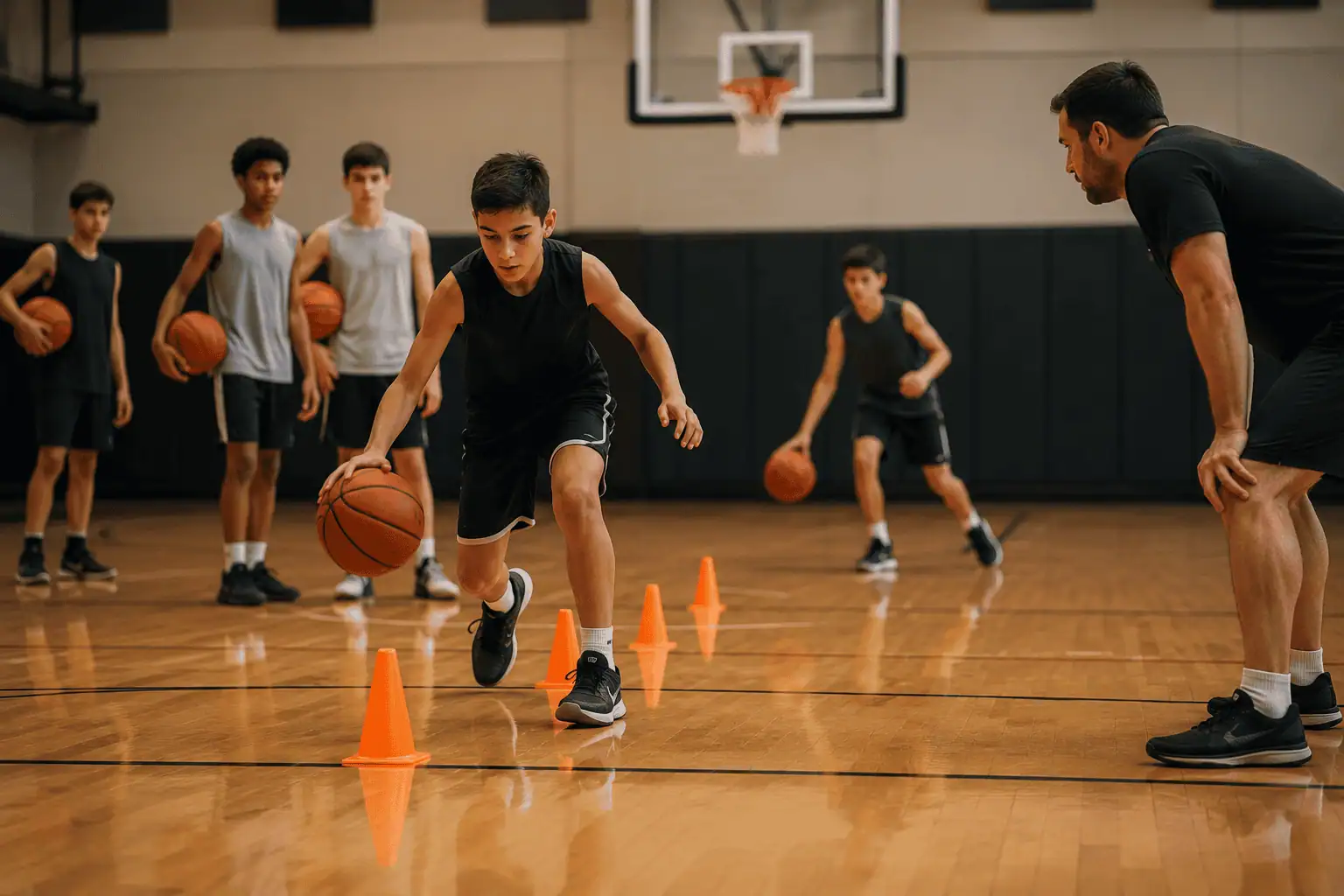
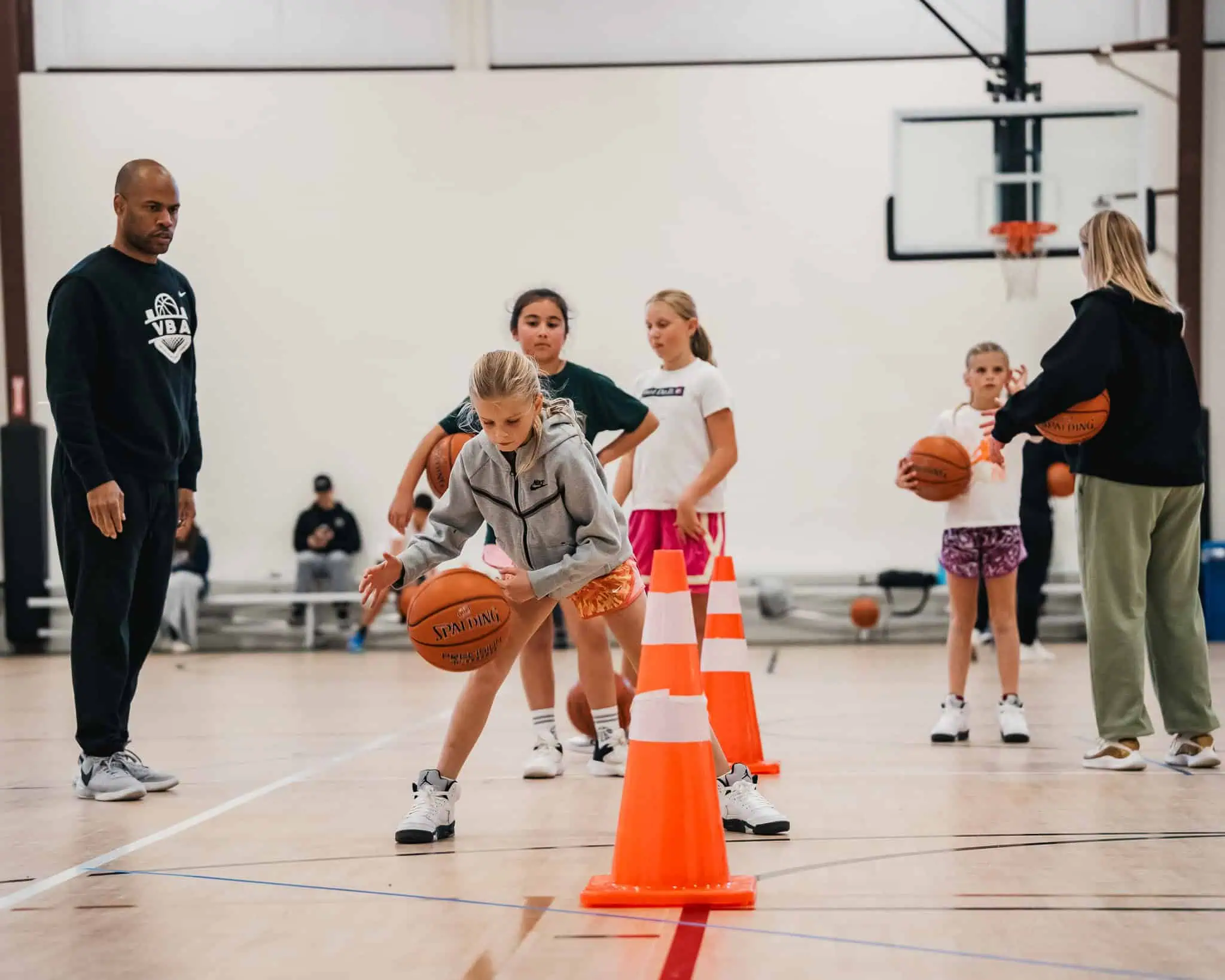
Once you are comfortable controlling the ball while stationary, add movement. Cone drills introduce changes of direction, footwork, and speed while requiring you to maintain control.
6. Zig-Zag Dribbling Drill
The zig-zag drill teaches players to change direction while dribbling and closely resembles situations where an offensive player needs to attack around a defender.
How to do it:
- Set up five or six cones in a zig-zag pattern.
- Start at the first cone.
- Dribble toward the next cone.
- Plant your outside foot before changing direction.
- Use a crossover or in-and-out move at each cone.
- Continue through the course and finish with a layup if a basket is available.
What it improves: Agility, Direction changes, Footwork, and Game-speed dribbling
Coach’s tip: Slow down slightly before each cone. Rushing into the turn can make it harder to maintain control.
7. Cone Weave Dribbling Drill
The cone weave teaches players to navigate through tighter spaces while maintaining control of the basketball.
How to do it:
- Place cones in a straight line with about 3 to 4 feet between them.
- Start dribbling toward the first cone.
- Weave around each cone while keeping the dribble controlled.
- Add crossovers, V-dribbles, or in-and-out moves as you progress.
- Keep your eyes up as much as possible.
- Finish with a layup or short jump shot if a basket is available.
What it improves: Close ball control, Footwork, Court awareness, and Balance while moving
Common mistake: Avoid staring at the cones or basketball throughout the entire drill. Practice looking ahead so you can develop better court awareness.
8. Dribbling Obstacle Course
A dribbling obstacle course combines several ball-handling movements into one activity. It can be especially useful for younger players because it adds variety and competition to practice.
How to do it:
- Set up cones, chairs, floor markers, or other safe obstacles.
- Include sections for slalom dribbling, turns, and narrow lanes.
- Assign a specific move at selected checkpoints.
- Focus on maintaining control rather than simply completing the course as quickly as possible.
- Finish with a layup or jump shot when possible.
What it improves: Ball control while moving, Coordination, Agility, and Confidence in changing situations
Coach’s tip: Let younger players occasionally help design part of the course. It can make practice more engaging while encouraging creativity.
Advanced Basketball Dribbling Drills
Advanced drills should be introduced after players have developed reliable fundamentals. These exercises add coordination, speed, changes of pace, and pressure to make ball handling more game-like.
9. Figure 8 Dribbling
Figure 8 dribbling teaches players to move the basketball between their legs while using both hands. The exercise develops coordination and comfort handling the ball from different angles.
How to do it:
- Stand with your feet slightly wider than shoulder-width apart.
- Bend your knees into a low athletic stance.
- Start dribbling with your right hand.
- Push the ball between your legs to your left hand.
- Continue the movement back through your legs to create a figure 8 pattern.
- Keep the ball low and controlled.
- Increase speed gradually as your control improves.
Practice for 30 to 45 seconds before resting.
What it improves: Hand coordination, Ball control with both hands, Comfort dribbling between the legs, and Hand speed
Coach’s tip: Prioritize smooth, clean repetitions before trying to increase your speed.
10. Two-Ball Dribbling
Two-ball dribbling challenges both hands at the same time and can help players develop coordination and control on both sides of the body.
How to do it:
- Stand in a low athletic stance with one basketball in each hand.
- Begin dribbling both basketballs simultaneously.
- Keep the basketballs around waist height or lower.
- Once you can maintain control, walk forward and backward.
- Progress to alternating dribbles.
- Aim for 30 to 45 seconds before resting.
What it improves: Coordination, Weak-hand development, Rhythm, and Ball control under increased difficulty
Common mistake: Avoid watching only one basketball. Practice keeping your eyes forward while trusting your hands.
11. Change of Speed Drill
Changing speed can be just as important as changing direction. This drill teaches players to slow down and then accelerate to make their movement less predictable to defenders.
How to do it:
- Start dribbling at a relaxed pace.
- After several steps, accelerate into a faster dribble.
- Slow down again after a few more steps.
- Repeat the pattern across the court.
- Add a crossover or in-and-out move before accelerating as you improve.
- Complete four to six trips across the court.
What it improves: Acceleration, Body control, Offensive timing, and Ability to create separation
12. Retreat Dribble Drill
The retreat dribble teaches players how to create space when a defender applies pressure. Instead of forcing a drive, players learn to move backward under control before re-attacking.
How to do it:
- Begin facing an imaginary defender.
- Take one or two controlled dribbles forward.
- Push the ball backward while stepping away from the defender.
- Keep your body between the defender and the basketball.
- Once you create enough space, attack again with a crossover or quick first step.
- Repeat eight to 12 times on each side.
What it improves: Ball protection, Decision-making, Confidence under pressure, and Ability to recover against defensive pressure
Coach’s tip: Retreating does not mean giving up on the play. Creating space can give you a better opportunity to attack.
Fun Basketball Dribbling Drills
For younger players, adding games to practice can make skill development more enjoyable. These activities encourage players to control the basketball while reacting to other players and changing situations.
13. Dribble Tag
Dribble tag combines movement, awareness, and ball handling. Players must avoid being tagged while maintaining their dribble.
How to do it:
- Mark a playing area using cones.
- Give each player a basketball except the designated taggers.
- Players dribble around the area while avoiding the taggers.
- If tagged, complete a quick challenge such as five pound dribbles before returning.
- Rotate the taggers every few minutes.
- Play for five to 10 minutes.
What it improves: Ball protection, Court awareness, Quick reactions, and Confidence dribbling under pressure
14. Red Light, Green Light
Red Light, Green Light is a simple game that teaches younger players to start and stop while maintaining control of the basketball.
How to do it:
- Players line up on one baseline with a basketball.
- On “Green Light,” players dribble toward the opposite side.
- On “Red Light,” players stop while maintaining control.
- Players who lose control can move back a few steps before continuing.
- Play three to five rounds.
What it improves: Stop-and-start control, Balance, Body coordination, and Reaction skills
Coach’s tip: Add “Yellow Light” for slow dribbling once players understand the basic game.
15. Dribble Knockout
Dribble knockout teaches players to protect their own basketball while trying to knock away another player’s ball. It introduces pressure in a fun and competitive setting.
How to do it:
- Mark a playing area using the key or half court.
- Give every player a basketball.
- Players dribble while trying to knock other basketballs away.
- Players who lose their basketball complete a quick skill challenge before rejoining.
- Continue for several short rounds.
What it improves: Ball protection, Awareness, Change of direction, and Confidence under defensive pressure
Common mistake: Players can become focused on knocking away another ball and forget about their own. Control and protect your basketball first.
How Often Should You Practice Basketball Dribbling Drills?
Consistency matters more than occasional marathon sessions. Use the following as a general starting point and adjust the duration based on your age, skill level, overall training schedule, and recovery needs.
- Beginners: Practice for 10 to 15 minutes, three to four times per week. Focus on pound dribbles, stationary crossovers, V-dribbles, and weak-hand work.
- Youth Players: Practice for 15 to 20 minutes, three to five times per week. Combine stationary drills with cone work and fun games.
- Intermediate Players: Practice for 20 to 30 minutes, four to five times per week. Add movement drills, figure 8 dribbling, and changes of speed.
- Advanced Players: Practice for 30 to 45 minutes, five to six times per week as part of a balanced training schedule. Include two-ball work, movement drills, and game-speed combinations.
- Competitive Players: Dribbling can be incorporated into daily basketball training, but the overall workload should also include shooting, passing, defense, conditioning, games, and appropriate recovery..
Even a short, focused session can be useful when you practice consistently and pay attention to technique.
Common Basketball Dribbling Mistakes to Avoid
As your skills improve, watch for habits that can limit your control and make it harder to transfer your practice into games.
- Looking Down at the Ball: Keeping your eyes up helps you see teammates, defenders, and open space instead of focusing entirely on the basketball.
- Dribbling Too High: A high dribble can make the ball easier for defenders to reach. Keep the ball controlled and lower when you are under pressure.
- Using Your Palm Instead of Your Fingertips: Your fingertips give you better control over the basketball and help you make quicker adjustments during a dribble.
- Ignoring Your Weak Hand: If you only practice with your dominant hand, defenders can anticipate which direction you are likely to attack. Give your weaker hand regular practice time.
- Standing Too Upright: A balanced, athletic stance makes it easier to protect the ball, change direction, and accelerate.
- Trying to Go Too Fast Too Soon: Speed should come after control. Learn the movement correctly first, then gradually increase your pace.
- Practicing Without Game Situations: Stationary drills are useful for learning technique, but players eventually need to apply those skills while moving, changing direction, making decisions, and responding to pressure.
Closing Thoughts
Great ball handlers are built through consistent, purposeful practice. Whether you’re helping a young beginner learn the basics or preparing for more competitive basketball, the right basketball dribbling drills can improve ball control, coordination, weak-hand confidence, changes of direction, and decision-making.
Start with the fundamentals, increase the difficulty gradually, and focus on quality repetitions rather than simply trying to move as fast as possible. When you’re ready to take those skills into structured training, Valley Basketball Academy provides basketball development opportunities for young athletes.
Ready to take your basketball skills to the next level?
FAQs
1. What are the best basketball dribbling drills for beginners?
Beginners can start with pound dribbles, stationary crossovers, V-dribbles, and weak-hand dribbling. These exercises build basic ball control and coordination before players progress to movement-based drills.
2. What are the best basketball dribbling drills for youth players?
Youth players can combine fundamental exercises such as pound dribbles and crossovers with cone weaves, zig-zag dribbling, dribble tag, and dribble knockout. A combination of skill work and games can keep practice engaging while developing game-ready ball handling.
3. What are the best dribbling drills for 8-year-olds?
For 8-year-olds, simple drills such as pound dribbles, stationary crossovers, Red Light, Green Light, and dribble tag are good options. Keep sessions short, engaging, and focused on control rather than speed.
4. What are the best dribbling drills for 10-year-olds?
Ten-year-old’s can continue practicing the fundamentals while adding V-dribbles, cone weaves, zig-zag dribbling, figure 8s, and changes of speed. The difficulty should increase gradually as control improves.
5. How often should you practice basketball dribbling drills?
Beginners and youth players can start with about 10 to 20 minutes of focused dribbling practice three to five times per week. Consistency and good technique are more important than completing long sessions.
6. How can I improve my basketball dribbling at home?
Practice stationary drills such as pound dribbles, crossovers, V-dribbles, figure 8s, and weak-hand work. If you have enough safe space, cones or other floor markers can also be used to create simple movement drills.
7. Are cone drills good for improving basketball dribbling?
Yes. Cone drills can help players practice ball control, footwork, changes of direction, and movement while dribbling. They become more useful as players progress from stationary ball handling to game-speed movement.
8. How can I improve my weak-hand basketball dribbling?
Give your non-dominant hand dedicated practice time during every session. Start with simple pound dribbles and V-dribbles, then progress to cone drills and movement exercises as your control improves.
9. How long should beginners practice dribbling basketball each day?
Beginners can start with 10 to 15 minutes of focused practice. The exact amount can vary based on age, experience, and the player’s overall training schedule.
10. How can I make dribbling drills more challenging?
Increase the difficulty by lowering the dribble, increasing speed gradually, using your weak hand, adding cones, combining movements, changing direction, or introducing controlled defensive pressure.