Talk to us

If you want to become a better basketball player, simply spending more time on the court isn’t enough. The biggest improvements come from practicing with purpose and focusing on the skills you need to develop. Well-designed basketball drills help you build stronger fundamentals, develop confidence, and prepare for situations you’ll face during real games.
Whether you’re just learning the sport or looking to sharpen your game, knowing how to improve in basketball can help you make your practice time more effective. From ball handling and shooting to passing, defense, and footwork, the right approach can help you improve your basketball skills one step at a time. The basketball drills below give you practical ways to put that approach into practice and make every session count.
What Are the Benefits of Basketball Drills?
Basketball drills help players build the skills, coordination, and confidence they need to perform better during games. By practicing specific movements and situations repeatedly, players can turn key skills into natural habits.
A regular basketball drill routine can help you:
- Improve dribbling, shooting, passing, and footwork.
- Build better coordination, balance, and body control.
- React faster and more confidently during games.
- Improve decision-making under pressure.
- Develop better communication and teamwork.
- Build consistent habits that carry over into competition.
What Equipment Do You Need?
You don’t need a professional court to work on your game. Many basketball drills can be done with just a basketball and a little open space.
If you have access to a hoop and a few simple training tools, you’ll have even more ways to challenge yourself.
Here’s all you’ll typically need:
- Basketball: Use the correct size for your age group.
- Basketball hoop: Indoor, outdoor, or adjustable hoops all work.
- Cones or floor markers: Helpful for dribbling, footwork, and defensive drills.
- Agility ladder: Great for improving foot speed and coordination. Tape on the floor works as a simple substitute.
- Training pinnies: Useful during team practices and scrimmages.
- Stopwatch or timer: Helps keep drills competitive and practice moving at a good pace.
Best Basketball Drills for Players of All Skill Levels
Whether you’re a beginner or an experienced player, these basketball drills can help you build fundamental skills, improve your technique, and prepare for game situations.
A. Basketball Warm-Up Drills
A good practice starts before anyone takes their first shot.
Warming up helps your body move more freely, prepares your muscles for faster movements, and reduces the chance of injuries. It also gives you a few minutes to settle into practice before the intensity increases.
1. Dynamic Movement Warm-Up
A dynamic movement warm-up is a series of controlled movements that prepare your body for basketball. Instead of holding a stretch in one position, you keep moving through exercises such as jogging, high knees, lunges, leg swings, lateral shuffles, and defensive slides.
The goal is to gradually raise your heart rate, loosen your joints, and prepare your muscles for quick basketball movements.
How to Do It
- Start with light jogging around the court for 2 to 3 minutes.
- Add high knees, butt kicks, and arm circles.
- Perform walking lunges and leg swings on both sides.
- Add lateral shuffles and defensive slides.
- Include a few short sprints and quick changes of direction.
- Finish with light skips or jumps before starting practice.
What It Improves: Mobility, Coordination, Balance, Muscle activation, Readiness for basketball movements
2. Dribble and Move Warm-Up
The dribble and move warm-up combines basic dribbling with light movement around the court. You move at a comfortable pace while switching hands and using simple dribbling moves.
It helps your hands, feet, and eyes get comfortable working together before you move into harder ball-handling drills.
How to Do It
- Start by walking while dribbling with your dominant hand.
- Switch to your weaker hand after about one minute.
- Increase your pace to a light jog.
- Add simple crossovers and hesitation dribbles.
- Try a few behind-the-back dribbles once you feel comfortable.
- Keep your head up instead of watching the ball.
What It Improves: Ball control, Hand-eye coordination, Footwork, Weak-hand confidence, Dribbling while moving
Common Mistake: Do not start at full speed. Focus on controlling the basketball first and increase your pace gradually.
3. Partner Passing Warm-Up
A partner passing warm-up is a simple passing exercise where two players stand a short distance apart and pass the basketball back and forth. You can use chest passes, bounce passes, and overhead passes.
It gets players comfortable catching and passing before practice becomes more intense.
How to Do It
- Stand about 8 to 10 feet away from your partner.
- Start with chest passes.
- Move to bounce passes after a few repetitions.
- Add overhead passes.
- Gradually increase the passing speed and distance.
- Call your partner’s name before making each pass.
What It Improves: Passing accuracy, Catching, Communication, Timing and Passing technique
Coach’s Tip: Try completing 25 or 50 accurate passes without dropping the ball. Focus on making clean catches as well as accurate passes.
4. Layup Line Drill
The layup line drill is a basic basketball finishing drill where players take turns driving toward the basket and shooting layups. Players usually form two lines on opposite sides of the court, with one player shooting and another grabbing the rebound.
It is a simple way to warm up while practicing layups, footwork, and finishing with both hands.
How to Do It
- Create two lines on opposite sides of the basket.
- Have the first player dribble toward the basket.
- Finish with a layup.
- The player from the opposite line grabs the rebound.
- Rotate to the opposite line after each attempt.
- Practice layups with both the right and left hand.
- Increase the pace once everyone is comfortable.
What It Improves: Layup technique, Finishing, Footwork, Rebounding, and finishing with both hands
Coach’s Tip: Encourage players to practice their weaker hand. It gives them more options when they approach the basket from different angles.
5. Defensive Footwork Warm-Up
A defensive footwork warm-up teaches players to move sideways in a low defensive stance. Players slide from one point to another without crossing their feet and finish with a controlled closeout.
It prepares the legs for the lateral movements used when guarding an opponent.
How to Do It
- Start in a low defensive stance.
- Keep your knees bent and your chest up.
- Slide sideways from one marker to another.
- Do not cross your feet while sliding.
- Change direction and return to the starting point.
- Finish each repetition with a short closeout.
- Stay low throughout the movement.
What It Improves: Defensive stance, Lateral quickness, Balance, Footwork, and Closeout technique
B. Basketball Dribbling Drills
A good handle makes every other part of your game easier.
When you’re comfortable with the basketball, you spend less time worrying about your
dribble and more time reading the defense. The drills below focus on building control first,
then adding speed and game-like movement.
6. Pound Dribble
The pound dribble is a stationary ball-handling drill where you repeatedly bounce the basketball hard with one hand. The ball usually stays around knee height while you maintain a low athletic stance.
It is one of the simplest ways to practice controlling the basketball with each hand.
How to Do It
- Stand with your knees slightly bent.
- Keep your back straight and your eyes forward.
- Pound the ball firmly with your right hand for 20 to 30 seconds.
- Switch to your left hand.
- Keep the ball close to your body.
- Repeat while walking once you become comfortable.
What It Improves: Ball control, Hand strength, Weak-hand confidence, and Dribbling control
Coach’s Tip: Keep your eyes up. Try to feel where the ball is instead of looking down at every bounce.
7. Stationary Crossovers
A stationary crossover is a dribbling drill where you move the basketball from one hand to the other in front of your body without moving from your spot.
It helps you practice the basic crossover before using it while running or attacking a defender.
How to Do It
- Stand in a low athletic stance.
- Keep your feet slightly wider than shoulder width.
- Dribble the ball in front of your body.
- Move it quickly from your right hand to your left.
- Immediately return it to your right hand.
- Keep the ball below your waist.
- Increase your speed while maintaining control.
What It Improves: Hand coordination, Ball control, Balance, Direction changes, and Crossover technique
8. Zig-Zag Dribbling
Zig-zag dribbling is a movement drill where you dribble diagonally across the court, change direction, and attack toward the next marker. You can use crossovers, between-the-legs moves, or other changes of direction at each turn.
The drill teaches you to control the ball while changing direction and speed.
How to Do It
- Place several cones diagonally across the court.
- Start at one baseline.
- Dribble toward the first cone.
- Change direction using a controlled dribbling move.
- Accelerate toward the next cone.
- Repeat until you reach the other end.
- Return using a different dribbling move.
What It Improves: Ball control while moving, Agility, Change of direction, First-step quickness, and Change of pace
Common Mistake: Do not stop completely before changing direction. Try to stay controlled while moving through each turn.
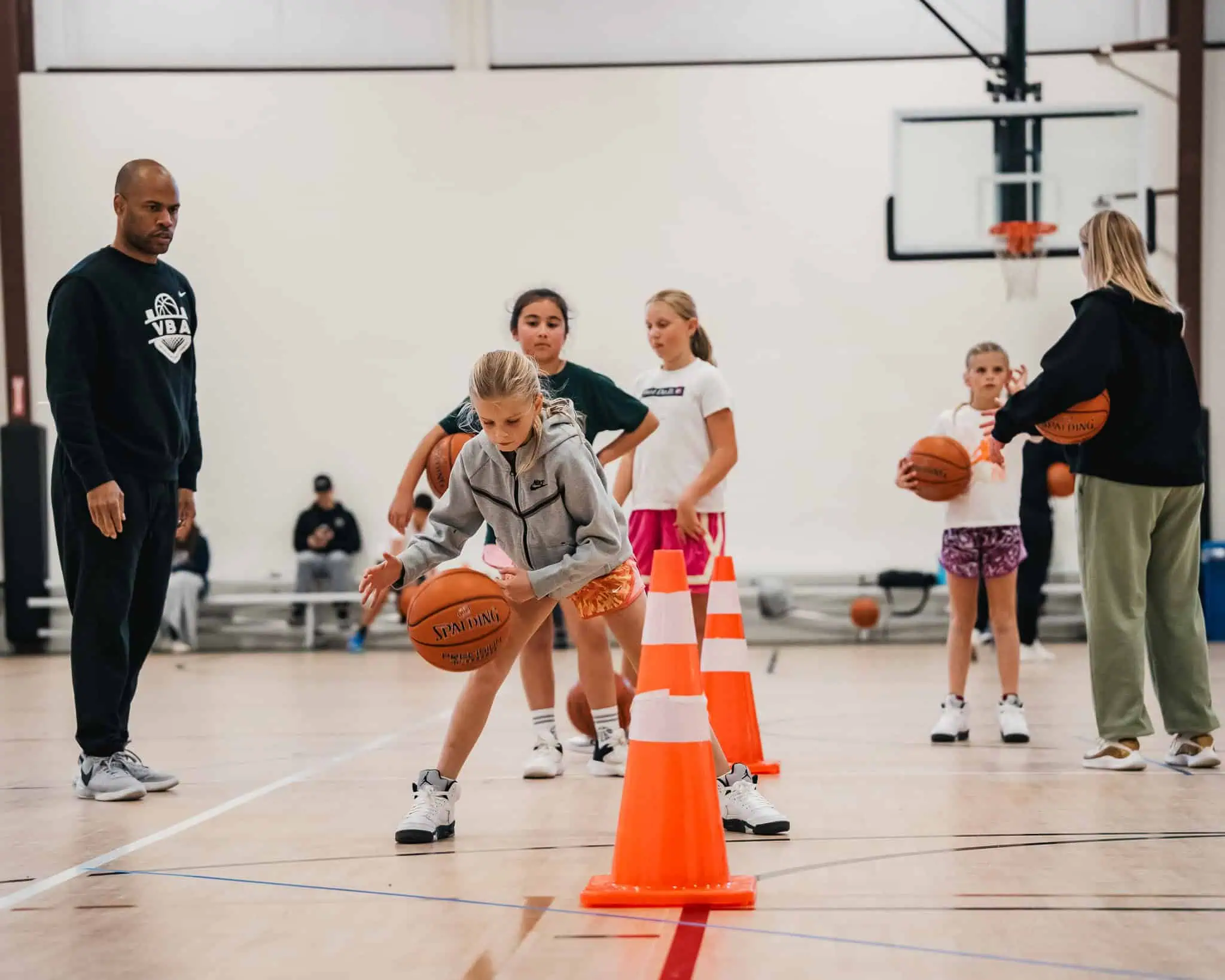
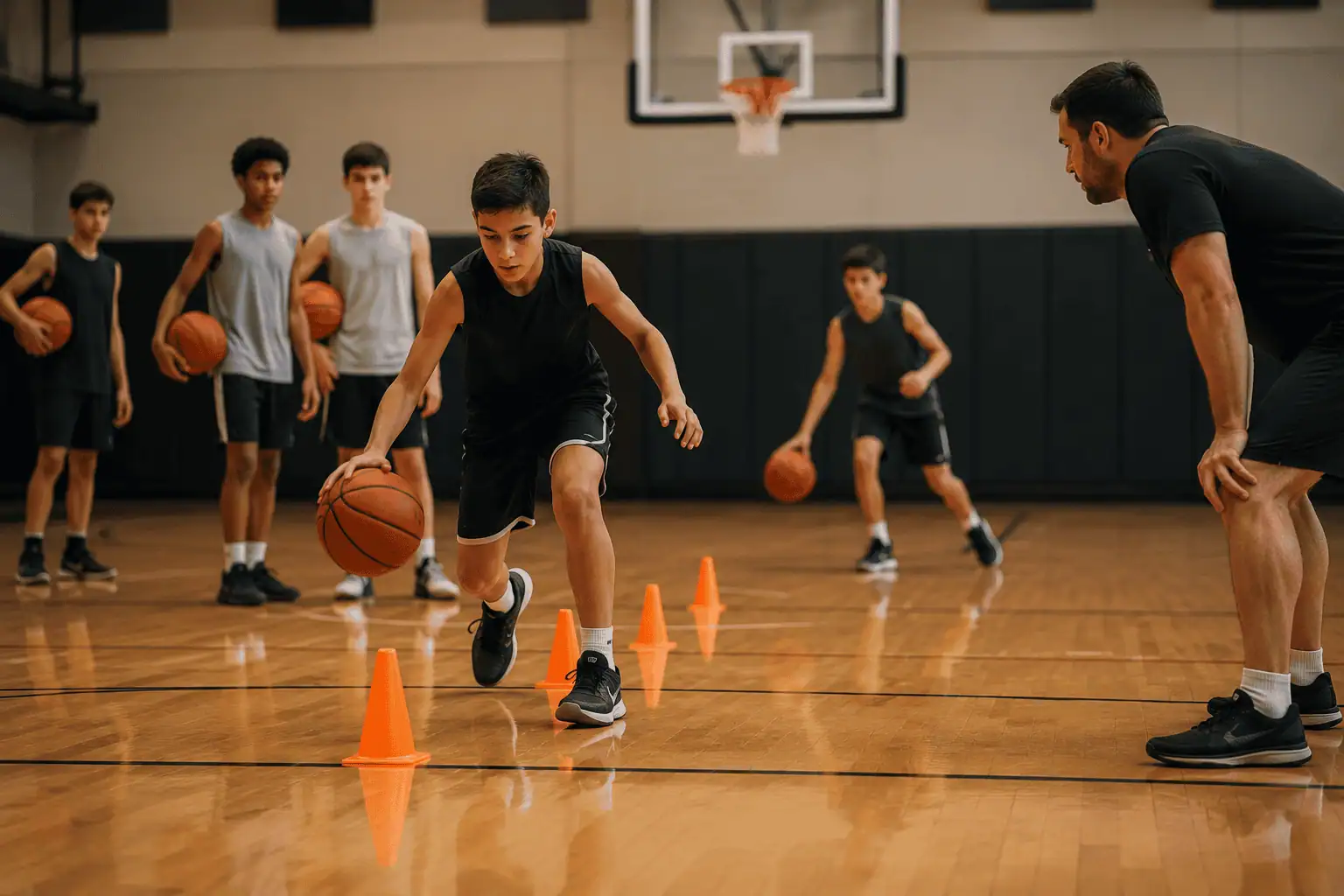
9. Cone Weave Dribbling Drill
The cone weave is a dribbling drill where you move the basketball through a line of cones without touching them. Players can use crossovers, between-the-legs dribbles, or in-and-out moves while weaving through the course.
It is useful for practicing close ball control and changing direction.
How to Do It
- Place 5 or 6 cones about 2 to 3 feet apart.
- Start at one end of the cone line.
- Dribble around each cone.
- Use a different dribbling move when changing direction.
- Keep your head up as much as possible.
- Turn around at the final cone.
- Repeat using your other hand.
What It Improves: Close ball control, Agility, Coordination, Direction changes, and Confidence with the ball
10. Two-Ball Dribbling
Two-ball dribbling is a ball-handling drill where you dribble two basketballs at the same time, using one ball in each hand. You can start by bouncing both balls together and then progress to alternating dribbles.
It forces both hands to work independently.
How to Do It
- Stand in a low athletic stance.
- Hold one basketball in each hand.
- Dribble both basketballs at the same time.
- Try alternating the dribbles once you are comfortable.
- Change the height of each dribble.
- Walk slowly while dribbling both balls.
- Return to stationary dribbling if you lose control.
What It Improves: Hand coordination, Hand speed, Weak-hand control, and Ball-handling confidence
Coach’s Tip: Do not worry about losing the ball at first. Two-ball dribbling is supposed to challenge your coordination.
C. Basketball Shooting Drills
Every shooter wants to make more baskets, but taking hundreds of random shots usually isn’t the answer.
The best shooting workouts focus on quality instead of quantity. Build good habits first, then add speed, movement, and pressure as your mechanics become more consistent.
11. Form Shooting Drill
Form shooting is a close-range shooting drill that focuses on the basic parts of your shooting motion. You shoot from a short distance so you can pay attention to your balance, hand position, elbow, wrist, and follow-through.
It is usually performed before moving to longer shots.
How to Do It
- Stand a few feet from the basket.
- Keep your feet balanced and comfortable.
- Hold the ball correctly in your shooting hand.
- Focus on your elbow and wrist position.
- Shoot with a smooth motion.
- Hold your follow-through after every shot.
- Move farther away only when your form stays consistent.
What It Improves: Shooting mechanics, Balance, Follow-through, Shooting consistency, and Muscle memory
12. Spot Shooting Drill
Spot shooting is a basketball shooting drill where you take several shots from different fixed locations on the court. Common spots include the corners, wings, and top of the key.
Once you’re comfortable creating space with your dribble, the next step is learning to finish the play. Work on your basketball shooting technique and drills to become a more complete offensive player.
How to Do It
- Choose 5 shooting spots around the court.
- Start at the first spot.
- Take a set number of shots.
- Move to the next spot.
- Set your feet before each shot.
- Keep the same shooting motion at every location.
- Record how many shots you make from each spot.
What It Improves: Shooting accuracy, Range, Footwork, Shooting consistency, and Confidence
Coach’s Tip: Keep track of your makes. Your shooting percentage gives you a simple way to see whether your practice is actually improving.
13. Around the World
Around the World is a basketball shooting game where you shoot from several spots around the court, usually moving around the perimeter after making each shot.
It combines shooting practice with a little competition, making it useful for both individual and group workouts.
How to Do It
- Choose several shooting spots around the key.
- Start from the first spot.
- Make a shot before moving to the next position.
- Continue around the court.
- Count how many attempts you need to finish.
- Add a miss limit if you want to make the game harder.
What It Improves: Shooting from different angles, Concentration, Shooting confidence, and Competitive focus
14. Catch-and-Shoot Drill
The catch-and-shoot drill teaches you to shoot immediately after receiving a pass. Instead of dribbling first, you prepare your feet, catch the ball, and move directly into your shooting motion.
This closely matches the quick shots players often get during games.
How to Do It
- Have a teammate stand near the passing position.
- Move to a shooting spot.
- Prepare your feet before the pass arrives.
- Catch the ball with your hands ready to shoot.
- Move directly into your shot.
- Hold your follow-through.
- Change shooting spots after each attempt.
What It Improves: Shot preparation, Footwork, Release speed, Catching, and Game-speed shooting
Common Mistake: Do not wait until you catch the ball to think about your feet. Get your body ready before the pass reaches you.
15. Free Throw Drill
The free throw drill helps players practice shooting from the free throw line while building a consistent routine. Since there is no defender during a free throw, the focus is on technique, rhythm, and concentration.
How to Do It
- Stand at the free throw line.
- Use the same routine before every shot.
- Take a few controlled dribbles.
- Take a breath and focus on the basket.
- Shoot without rushing.
- Repeat for sets of 10 or 20 shots.
- Record your percentage after each set.
What It Improves: Free throw accuracy, Shooting routine, Concentration and Confidence under pressure
D. Basketball Passing Drills
A good pass often creates an easier shot than a difficult dribble ever could.
The best passers aren’t always the flashiest players on the court. They’re the ones who consistently deliver the ball to the right teammate at the right time. These drills help build that consistency.
16. Partner Passing Drill
The partner passing drill is a basic exercise where two players stand several feet apart and pass the basketball to each other. Players can practice chest passes, bounce passes, and overhead passes.
The goal is to deliver the ball accurately so the other player can catch it without breaking their rhythm.
How to Do It
- Stand 8 to 15 feet apart.
- Start with chest passes.
- Move to bounce passes.
- Practice overhead passes.
- Increase the distance gradually.
- Add movement once your passing becomes consistent.
- Keep every pass firm and controlled.
What It Improves: Passing accuracy, Catching, Timing, Communication, and Passing technique
17. Wall Passing Drill
The wall passing drill lets you practice passing without a teammate. You stand in front of a sturdy wall and repeatedly pass the basketball against a specific target before catching it.
It is a useful solo drill for improving accuracy and hand speed.
How to Do It
- Stand several feet away from a sturdy wall.
- Mark a small target on the wall.
- Throw chest passes toward the target.
- Catch the ball after it rebounds.
- Practice bounce and overhead passes.
- Move slightly between repetitions.
- Try to complete 50 or 100 accurate passes.
What It Improves: Passing accuracy, Hand speed, Catching, Consistency, and Solo basketball practice
Coach’s Tip: Use a small target instead of the entire wall. It forces you to be more precise with every pass.
18. Three-Man Weave
The three-man weave is a passing drill involving three players who move down the court while passing the basketball. After passing, each player runs behind the teammate who receives the ball.
It teaches players to pass while moving and maintain spacing during a fast break.
How to Do It
- Place three players across the court.
- Start moving toward the opposite basket.
- Pass the ball to one of the players on the side.
- Run behind the player who receives the pass.
- Continue the passing pattern down the court.
- Finish with a layup.
- Increase the speed as players become comfortable.
What It Improves: Passing on the move, Court spacing, Communication, Timing, and Transition offense
19. Passing on the Move
Passing on the move is a drill where players run while passing the basketball to teammates. Unlike stationary passing, players must judge the speed and position of a moving teammate.
This makes it useful for practicing passes during fast breaks and transition plays.
How to Do It
- Create two lines facing each other.
- Have players begin moving toward the opposite side.
- Pass the basketball while running.
- Lead your teammate instead of passing directly behind them.
- Continue to the opposite line.
- Add cones or defenders as players improve.
What It Improves: Passing at game speed, Timing, Coordination, Decision-making, and Passing accuracy
20. Circle Passing Drill
The circle passing drill places several players in a circle and has them pass the basketball around the group. Players can change the direction or type of pass as the drill continues.
It helps players practice quick reactions while staying aware of their teammates.
How to Do It
- Have players form a large circle.
- Start with regular chest passes.
- Change the direction of the ball.
- Add bounce and overhead passes.
- Try skip passes across the circle.
- Call out changes in direction or passing style.
- Increase the speed while maintaining accuracy.
What It Improves: Passing awareness, Quick reactions, Communication, Catching, and Passing under pressure
E. Basketball Defensive Drills
Scoring points wins attention. Defense wins possessions.
Players who defend well don’t always fill the stat sheet, but they consistently make life difficult for the other team. The drills below help develop the footwork, positioning, and habits that strong defenders rely on every game.
21. Defensive Slide Drill
The defensive slide drill teaches players how to move sideways while staying in a defensive stance. You slide from one point to another without crossing your feet.
It helps defenders stay in front of an opponent who moves laterally.
How to Do It
- Place two cones about 10 to 15 feet apart.
- Start in a low defensive stance.
- Keep your knees bent and hands ready.
- Slide toward the first cone.
- Keep your feet from crossing.
- Change direction and slide back.
- Stay low throughout the drill.
What It Improves: Lateral quickness, Defensive footwork, Balance, Defensive positioning, and Lower-body endurance
Common Mistake: Avoid standing up between slides. Staying low helps you change direction more quickly.
22. Closeout Drill
A closeout drill teaches defenders how to approach an offensive player who has just received the basketball. The defender sprints toward the player, slows down near them, and finishes in a balanced stance.
The goal is to contest the shot without allowing an easy drive.
How to Do It
- Start several steps away from a teammate or cone.
- Sprint toward the target.
- Slow down as you get closer.
- Raise one hand to contest the shot.
- Keep your feet balanced.
- Leave enough space to react to a drive.
- Repeat from different angles.
What It Improves: Closeout technique, Defensive balance, Body control, Shot contesting, and Reaction speed
23. Mirror Drill
The mirror drill pairs two players together. One player moves in different directions while the other player copies those movements as closely as possible.
It teaches defenders to react to an opponent’s movement instead of guessing where they will go.
How to Do It
- Pair up with a teammate.
- Choose one player as the leader.
- Have the leader move left, right, forward, and backward.
- The defender mirrors every movement.
- Stay in a low defensive stance.
- Avoid crossing your feet.
- Switch roles after 20 to 30 seconds.
What It Improves: Reaction speed, Defensive footwork, Agility, Concentration, and Body control
Coach’s Tip: You do not need a basketball for this drill. Focus on quick movement and staying in front of your partner.
24. One-on-One Containment Drill
The one-on-one containment drill puts an offensive player and defender against each other. The offensive player tries to reach the basket while the defender tries to stay in front and prevent an easy scoring opportunity.
The focus is on defensive positioning rather than reaching for steals.
How to Do It
- Start one offensive player and one defender at the top of the key.
- Give the offensive player the basketball.
- Allow the offensive player to attack the basket.
- Keep the defender between the ball and the basket.
- Avoid reaching for the ball.
- Rotate after each possession.
- Limit the number of dribbles to make the drill faster.
What It Improves: On-ball defense, Defensive positioning, Footwork, Discipline, and One-on-one defense
25. Shell Drill
The shell drill is a team defensive exercise that teaches players how to move together when the basketball changes positions. Defenders practice help defense, communication, and recovering to their assignments.
It is commonly used to teach team defensive habits.
How to Do It
- Place four offensive players around the perimeter.
- Match four defenders with them.
- Move the basketball around the perimeter.
- Have defenders shift into help positions.
- Communicate with teammates throughout the drill.
- Recover to the correct player when the ball moves.
- Pause and correct positioning when needed.
What It Improves: Team defense, Help defense, Communication, Defensive awareness, and Rotations
F. Basketball Conditioning Drills
Basketball requires players to sprint, stop, jump, and change direction repeatedly. Conditioning helps you maintain your energy and technique as the game continues.
26. Suicide Runs
Suicide runs are a basketball conditioning drill made up of repeated sprints between the baseline, free throw line, half court, opposite free throw line, and opposite baseline.
The constant sprinting and changes of direction make this a demanding endurance exercise.
How to Do It
- Start on the baseline.
- Sprint to the nearest free throw line and return.
- Sprint to half court and return.
- Sprint to the opposite free throw line and return.
- Sprint to the opposite baseline and return.
- Rest briefly.
- Repeat according to your fitness level.
What It Improves: Speed, Basketball endurance, Sprint recovery, Change of direction, and Mental toughness
27. Full-Court Dribble Sprints
Full-court dribble sprints combine conditioning with ball handling. You dribble quickly from one baseline to the other, finish with a layup, collect the rebound, and immediately return down the court.
The drill helps you control the ball while moving at a high speed.
How to Do It
- Start at one baseline with the basketball.
- Dribble toward the opposite baseline.
- Keep the ball under control while moving quickly.
- Finish with a layup.
- Grab the rebound immediately.
- Turn and dribble back.
- Repeat for several trips.
What It Improves: Conditioning, High-speed ball control, Finishing while tired, Transition play, and Sprint endurance
28. Lane Slides
Lane slides are a defensive conditioning drill where you move sideways across the lane while staying in a low defensive stance. The drill focuses on the type of lateral movement defenders use repeatedly during games.
How to Do It
- Start on one side of the key.
- Get into a low defensive stance.
- Slide to the opposite side.
- Keep your feet from crossing.
- Immediately slide back.
- Continue for 20 to 30 seconds.
- Rest before starting another set.
What It Improves: Defensive endurance, Lateral speed, Lower-body strength, Balance, and Defensive footwork
Coach’s Tip: Do not sacrifice your defensive stance just to move faster. If your form starts breaking down, slow down or take a short rest.
G. Basketball Team Drills
Basketball is a team sport, so individual skills are only part of the game. Team drills help players work on spacing, communication, passing, movement, and decision-making together.
29. Fast Break Drill
The fast break drill teaches players how to move quickly from defense to offense after gaining possession. Players run in different lanes while moving the basketball toward the basket with quick passes.
It helps players understand spacing and decision-making during transition offense.
How to Do It
- Start with three or more players at one end of the court.
- Push the basketball quickly up the floor.
- Have players run in separate lanes.
- Use quick passes instead of holding the ball.
- Finish with a layup.
- Immediately transition back down the court.
- Add defenders as players improve.
What It Improves: Transition offense, Passing on the move, Court spacing, Communication, and Decision-making
30. Half-Court Scrimmage
A half-court scrimmage is a shortened basketball game played on one half of the court. Coaches can add specific rules to make players focus on skills such as passing, spacing, defense, or decision-making.
It gives players a chance to use their skills in situations that feel more like a real game.
How to Do It
- Divide players into two teams.
- Start a game on one half of the court.
- Add a rule such as requiring three passes before a shot.
- Limit the number of dribbles if needed.
- Encourage players to communicate.
- Stop play occasionally to correct positioning.
- Resume play and let players apply the correction.
What It Improves: Decision-making, Team communication, Offensive movement, Defensive rotations, and Game awareness
H. Fun Basketball Drills for Kids
Basketball practice should not always feel like hard work, especially for younger players. Games and friendly competitions can help children practice basketball skills while keeping them interested and involved.
31. Dribble Relay Race
A dribble relay race turns basic dribbling into a team competition. Players take turns dribbling through a short course before returning and passing the turn to a teammate.
It is a simple way to work on ball control while keeping younger players moving.
How to Do It
- Divide players into small teams.
- Create a short cone course.
- Give the first player in each team a basketball.
- Have them dribble through the course.
- Return to the starting point.
- Pass the turn to the next teammate.
- Continue until every player has completed the course.
- Change the dribbling requirement for each round.
What It Improves: Ball control, Speed, Teamwork, Coordination, and Confidence
32. Knockout
Knockout is a basketball shooting game where players compete to make a basket before the player behind them. If a player scores before the person ahead of them, the player in front is eliminated.
The game adds pressure and competition to basic shooting practice.
How to Do It
- Have players line up at the free throw line.
- Give the first two players a basketball.
- The first player takes a shot.
- The second player shoots as soon as the first player releases.
- If the second player scores first, the first player is eliminated.
- Players continue until only one person remains.
What It Improves: Shooting under pressure, Rebounding, Quick shooting, Concentration, and Competitive confidence
33. H.O.R.S.E.
H.O.R.S.E. is a basketball shooting game where players take turns choosing shots for the other players to copy. A player receives a letter when they fail to make a shot that another player made.
The game encourages players to try different shots while keeping practice fun.
How to Do It
- Decide who shoots first.
- The first player chooses a shot.
- Other players try to make the same shot.
- A player who misses receives a letter.
- Continue with the next player choosing a shot.
- Eliminate a player when they spell H.O.R.S.E.
- Add trick shots or dribbling limits for more variety.
What It Improves: Shooting touch, Shot creativity, Confidence, Concentration, and Competitive mindset
34. Sharks and Minnows
Sharks and Minnows is a basketball dribbling game where most players try to dribble from one side of the court to the other while one or more defenders try to knock their basketball away.
It gives younger players a fun way to practice ball protection and dribbling under pressure.
How to Do It
- Give most players a basketball.
- Choose one or two players to be the sharks.
- Have the remaining players line up at one baseline.
- The players dribble toward the opposite baseline.
- Sharks try to knock the basketball away.
- Players who lose their basketball become sharks in the next round.
- Continue until only one minnow remains.
What It Improves: Ball protection, Dribbling under pressure, Court awareness, Reaction speed, and Confidence
Basketball Drills You Can Practice at Home
You don’t need access to a full court every day to improve your game. In fact, many players make some of their biggest improvements by practicing consistently at home.
If you have a basketball and a small open space, try adding a few of these drills to your routine:
- Pound dribbles: Build stronger ball control and improve your weaker hand.
- Stationary crossovers: Practice changing direction while keeping your eyes up.
- Wall passing: Improve passing accuracy and catching without needing a teammate.
- Form shooting: If you have a hoop, spend a few minutes each day shooting close to the basket with proper technique.
- Footwork drills: Defensive slides, jump stops, pivots, and agility ladder exercises all require very little space.
Even 20 to 30 minutes of focused practice a few times each week can make a noticeable difference over the course of a season.
How to Choose Basketball Drills Based on Your Skill Level
Not every drill is right for every player. Choosing drills that match your current ability helps you improve faster and keeps practice enjoyable.
- Beginners: If you’re new to basketball, spend most of your time building strong fundamentals. Focus on drills such as: Dynamic Movement Warm-Up, Pound Dribble, Stationary Crossovers, Form Shooting, Partner Passing,
- Intermediate Players: Players with a solid understanding of the basics should begin combining skills and practicing at a faster pace. Focus on drills such as: Zig-Zag Dribbling, Cone Weave Drill, Catch-and-Shoot, Defensive Slide Drill, Fast Break Drill
- Advanced Players: Experienced players benefit most from drills that closely resemble real game situations. Focus on drills such as: Two-Ball Dribbling, One-on-One Containment, Shell Drill, Half-Court Scrimmages, Full-Court Dribble Sprints
How to Choose Basketball Drills by Age Group
As players grow, the focus of practice should grow with them. A drill that’s perfect for a high school athlete may not be the best choice for a seven-year-old who’s still learning the basics.
- Ages 5 to 8 – At this age, the goal is to make basketball enjoyable while introducing basic skills. Focus on drills such as: Sharks and Minnows, Dribble Relay Races, Layup Lines, H.O.R.S.E., Basic Partner Passing
- Ages 9 to 12 – Players in this age group are ready to build stronger fundamentals and begin learning more structured game concepts. Focus on drills such as: Zig-Zag Dribbling, Spot Shooting, Catch-and-Shoot, Defensive Slides, Three-Man Weave
- Ages 13 and Up – Older players should spend more time practicing at game speed while improving their decision-making and conditioning. Focus on drills such as: Two-Ball Dribbling, Shell Drill, One-on-One Containment, Suicide Runs, Half-Court Scrimmages
Sample 60-Minute Basketball Practice Routine
If you’re not sure how to organize a workout, here’s a simple routine that covers the fundamentals without feeling overwhelming.
| Time | Activity |
|---|---|
| 10 minutes | Dynamic warm-up and movement drills |
| 15 minutes | Ball-handling drills |
| 15 minutes | Shooting drills |
| 10 minutes | Passing or defensive drills |
| 10 minutes | Scrimmage or conditioning |
As you become more comfortable, adjust the routine based on the skills you want to improve. For example, a player working on shooting might spend extra time on form shooting and spot shooting, while someone preparing for tryouts may dedicate more time to conditioning and defensive drills.
Closing Thoughts
There’s no single drill that will instantly make you a better basketball player. Real improvement comes from practicing consistently, paying attention to the fundamentals, and challenging yourself a little more each time you step onto the court.
Start with a handful of drills that match your current skill level instead of trying to do everything at once. As those drills become easier, add new ones to keep pushing yourself. Over time, those small improvements add up and become noticeable during games.
If you’re looking for a place to put these drills into action, improve your skills with experienced coaches, and train alongside other athletes, Valley Athletics offers basketball programs for players of different ages and experience levels. Whether your goal is to learn the basics or prepare for competitive play, practicing in the right environment can help you continue building confidence on the court.
Ready to put your skills to work? Explore Valley Basketball Academy and find the right training opportunity for you.
FAQs
1. How often should I practice basketball drills?
Aim for three to five practice sessions each week if possible. Even shorter workouts can lead to steady improvement when you practice consistently and stay focused.
2. How long should a basketball practice session last?
Most individual practices last between 45 and 90 minutes, depending on your age, experience, and goals. Younger players generally benefit from shorter sessions with frequent breaks.
3. Which basketball drill is best for beginners?
Simple drills like pound dribbles, form shooting, partner passing, and layup lines are great starting points because they build the fundamentals used in every game.
4. Can I improve my basketball skills without a court?
Yes. Many ball-handling, passing, footwork, and conditioning drills can be practiced at home or in any safe open space. Consistency is often more important than having access to a full court every day.
5. Should I practice game-speed drills every session?
Not necessarily. It’s better to learn proper technique first and then gradually increase your speed. Practicing with poor form at full speed can make bad habits harder to correct later.