Talk to us

If you’re new to volleyball, learning common volleyball terms can make practices, games, and coaching instructions much easier to understand. You may hear a teammate call for a “free ball,” a coach ask for a better “dig,” or a hitter say they “tooled” the block. What do these terms actually mean?
This guide explains more than 80 volleyball terms in plain language, covering basic skills, attacking, passing, serving, blocking, defense, rotations, scoring, court areas, player positions, and common on-court slang.
Whether you’re a young player learning the game, a parent watching your child compete, or a new fan trying to follow a match, this glossary gives you a practical way to understand what players and coaches are talking about.
Quick Volleyball Terms Every Beginner Should Know
Before getting into the full glossary, here are some of the volleyball terms you’re most likely to hear during practices and matches.
| Volleyball Term | Meaning |
|---|---|
| Ace | A serve that directly results in a point for the serving team. |
| Assist | A pass or set that directly contributes to a teammate’s kill, as recorded in match statistics. |
| Block | A defensive action at the net used to stop or redirect an opponent’s attack. |
| Dig | A defensive contact used to keep an opponent’s attack from hitting the floor. |
| Kill | An attack that results in a point for the attacking team. |
| Pass | A controlled contact used to direct the ball to a teammate. |
| Rally | The sequence of play from the serve until the point ends. |
| Serve | The contact that puts the ball into play. |
| Set | A controlled contact intended to position the ball for an attacker. |
| Spike | A forceful attacking hit directed into the opponent’s court. |
| Free Ball | A non-aggressive ball sent over the net that gives the opposing team time to organize its play. |
| Rotation | The required movement of players through serving positions after winning the right to serve. |
Basic Volleyball Terms & Actions
-
Ace
An ace is a serve that directly results in a point for the serving team. This can happen when the ball lands untouched or when the receiving team cannot make playable contact.
Aces are commonly tracked as individual match statistics because they show a server’s ability to create pressure.
-
Assist
An assist is a statistic credited to a player whose pass or set directly leads to a teammate’s kill. Setters receive most assists, although another player can earn one when they set up a successful attack.
-
Attack
An attack is an offensive attempt to send the ball over the net with the intention of scoring. A spike is one type of attack, but tips, roll shots, and other controlled offensive contacts can also be attacks.
-
Bump
Bump is an informal term for a forearm pass. The player brings the arms together to create a stable platform and uses the forearms to control the ball. Whereas “Forearm pass” is the more precise coaching term.
-
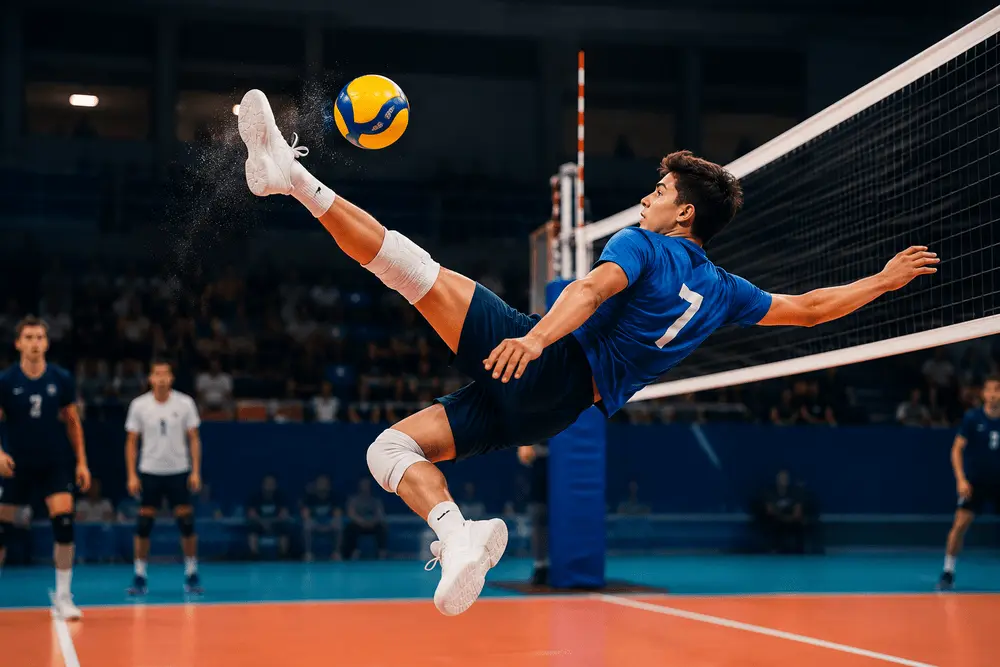
Dig
A dig is a defensive contact used to keep an opponent’s attack from hitting the floor. Most digs involve a forearm pass, but players may use their hands or other legal contacts when necessary.
-
Free Ball
A free ball is a non-aggressive ball sent over the net when a team cannot make a strong attack. Because the ball is easier to anticipate, the opposing team has more time to organize its offense. Players may call “free” to alert teammates that they have time to prepare.
-
Kill
A kill is an attack that results in a point for the attacking team. The ball may land in the opponent’s court, become unplayable after a defender’s contact, or otherwise result in a point credited to the attacker.
-
Pass
A pass is a controlled contact used to direct the ball toward a teammate. The term is especially common during serve receive, although defensive contacts may also be described as passes.
-
Rally
A rally begins with the serve and continues until the point ends because the ball is grounded, goes out, or a team commits a fault.
Some rallies last only a few seconds, while others develop into long exchanges involving several contacts and defensive saves.
-
Serve
The serve puts the ball into play. The server contacts the ball from behind the end line, using a serving technique such as an underhand, overhand, float, jump float, or topspin serve.
-
Set
A set is usually the second contact and is used to put the ball in a good position for an attacker. Setters adjust the height, speed, direction, and location of the ball depending on the play.
-
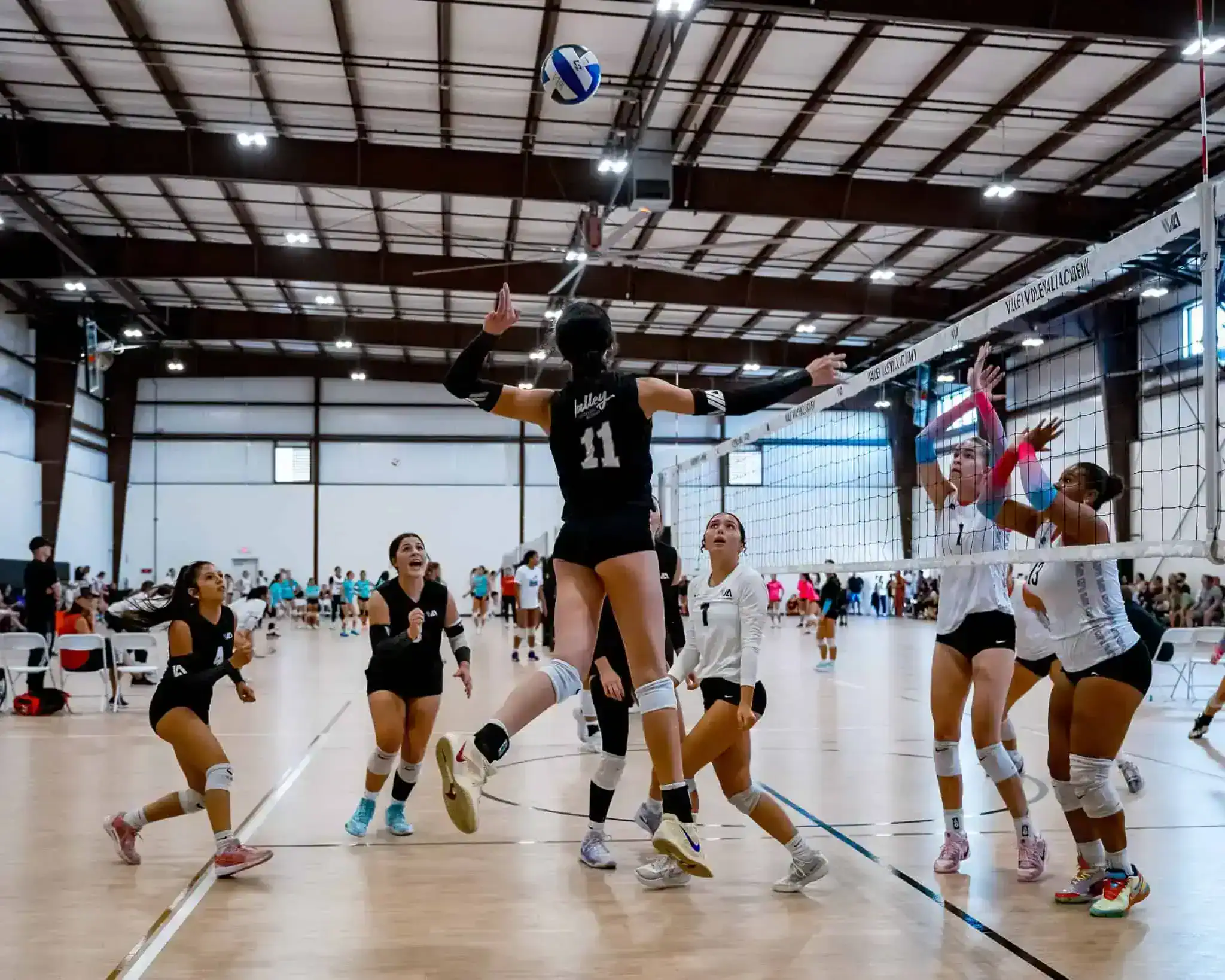
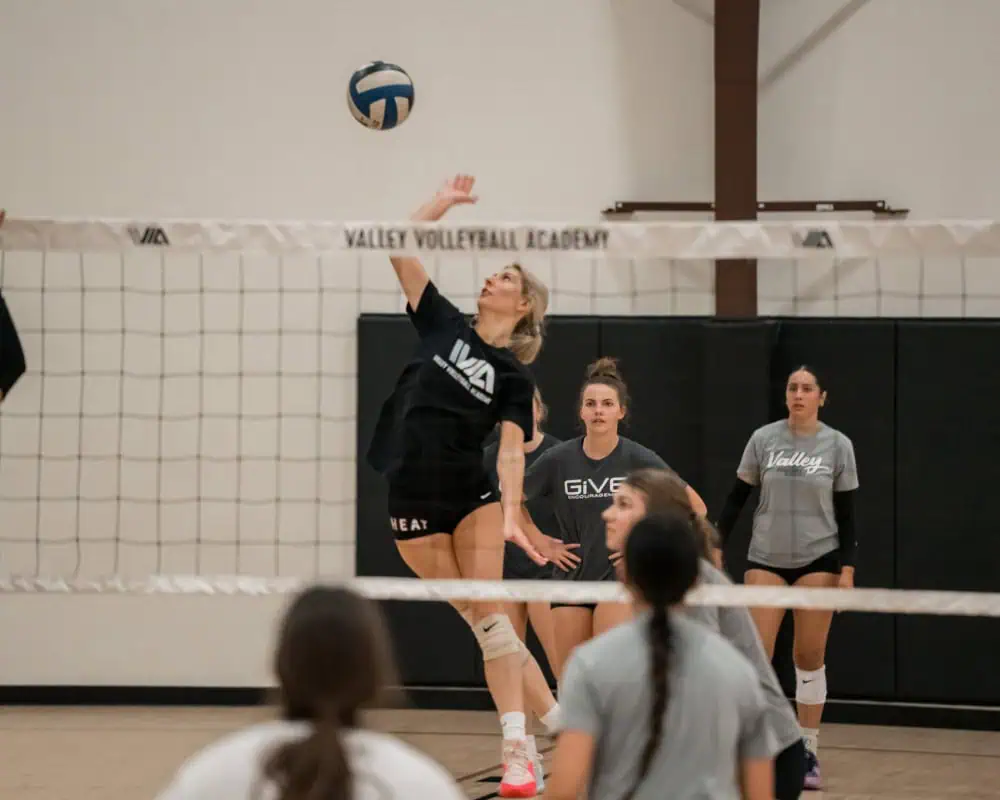
Spike
A spike is a forceful attacking hit, usually made after an approach and jump. The goal is to hit the ball with enough speed and placement to make it difficult for defenders to control.
Volleyball Hitting & Attacking Terms
-
Approach
An approach is the footwork a hitter uses before jumping to attack. Players commonly use a three- or four-step approach to build momentum and reach the ball in a strong hitting position.
-
Attack Error
An attack error occurs when an attacking play results in a point for the opposing team. Examples include hitting the ball out, hitting the net, or being blocked for a point.
-
Cross-Court Shot
A cross-court shot travels diagonally across the opponent’s court. For example, an outside hitter attacking from the left side may send the ball toward the opposite back corner.
-
Cut Shot
A cut shot is a sharply angled attack that travels across the net and lands relatively close to the hitter’s side of the opponent’s court. It can catch defenders who are positioned deeper for a traditional cross-court attack.
-
Tip
A tip is a soft attacking shot that sends the ball over or around the block into an open area. Instead of swinging with full power, the hitter uses control and placement.
“Dink” is another informal term you may hear players use for a similar type of soft attack.
-
Down Ball
A down ball is a coach or player call for an attack that is not a full jump swing, often because the attacker is sending the ball over without a conventional approach and jump.
The call helps defenders recognize that the opponent is unlikely to produce a full-power attack.
-
Line Shot
A line shot travels roughly parallel to the sideline. Hitters may use it when defenders are positioned inside the court expecting a cross-court attack.
-
Off-Speed Hit
An off-speed hit looks like it could become a hard attack, but the hitter deliberately reduces the pace. Changing speed can make the ball harder for defenders to anticipate.
-
Quick Attack
A quick attack is a fast set and attack, often involving a middle blocker. The goal is to attack before opposing blockers have enough time to get into position.
-
Roll Shot
A roll shot is a controlled attacking hit that sends the ball over the block with an arc. It can be useful when a hitter wants to place the ball into an open area rather than attack with maximum power.
-
Tool / Wipe
To tool or wipe the block means to deliberately attack off a blocker’s hands so the ball deflects out of bounds.
For example, a hitter may aim toward the outside hand of a blocker to create a deflection and win the point.
Volleyball Passing & Defensive Terms
-
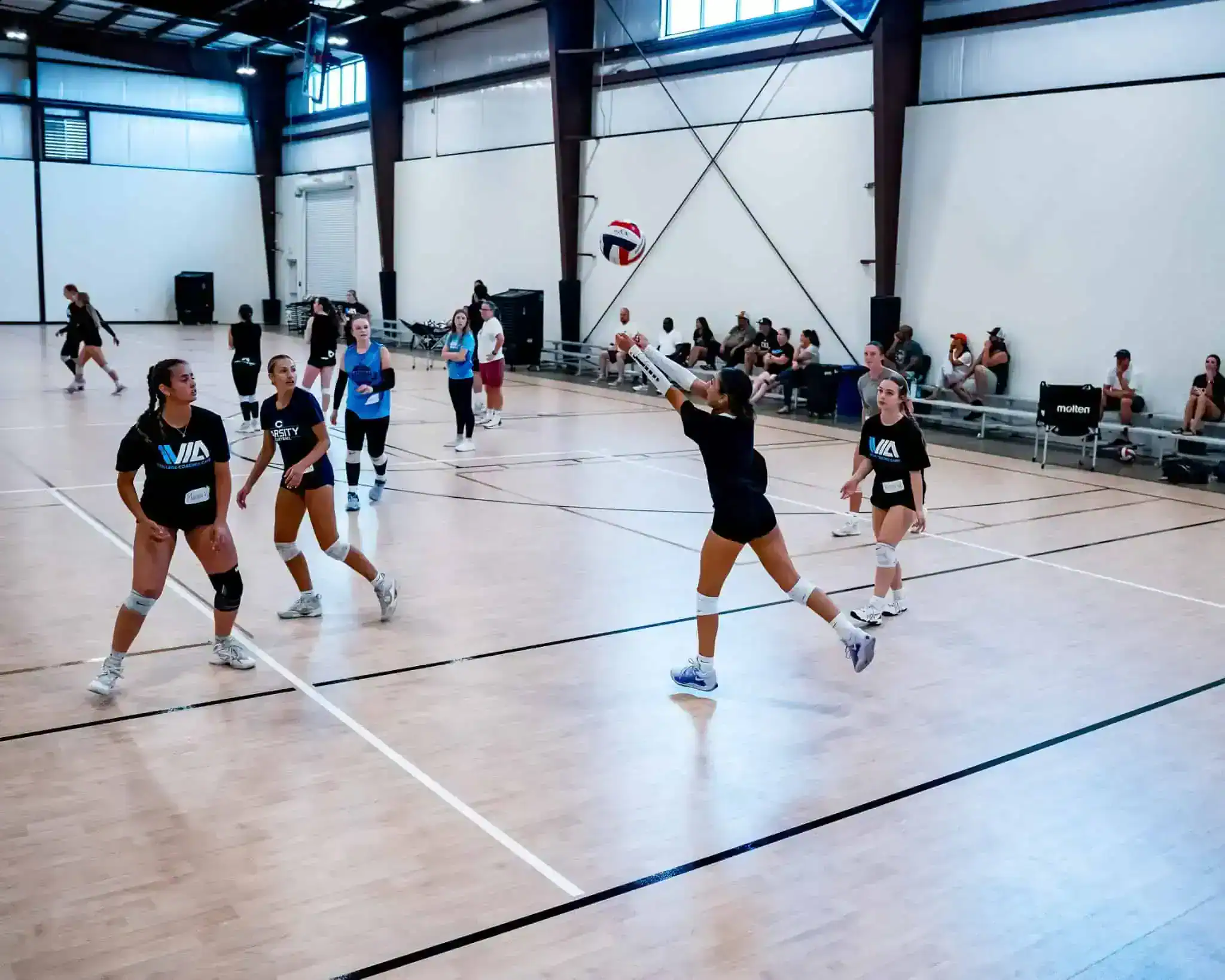
Forearm Pass
A forearm pass is a basic passing technique in which a player uses both forearms to control the ball. The player creates a stable platform and directs the ball toward a target.
Players can practice this skill through volleyball passing drills.
-
Serve Receive
Serve receive is the team’s formation and strategy for handling an opponent’s serve. Players position themselves to cover the expected serving area and try to pass the ball accurately toward the setter so the team can run its offense.
-
Pancake
A pancake is an emergency defensive save. A player places a flat hand on the floor and allows the ball to contact the back of the hand just before it reaches the ground.
It can keep a rally alive when a normal passing technique is not possible.
-
Overpass
An overpass occurs when a pass travels over the net instead of toward the setter or intended target. This can give the opposing team an immediate attacking opportunity.
-
Ready Position
The ready position is a balanced defensive stance with the knees bent, weight slightly forward, and the body prepared to move in any direction.
-
Coverage
Coverage means teammates positioning themselves around a hitter to keep a blocked or deflected attack from hitting the floor.
Good coverage gives the attacking team another opportunity to keep the rally alive.
-
Shank
A shank is a badly controlled pass that travels far away from the player’s intended target. It is an informal term you will often hear during practices and matches.
Volleyball Serving Terms
-
Underhand Serve
An underhand serve is contacted from below shoulder level, typically after the player holds or releases the ball in front of them. It is often one of the first serving techniques beginners learn because it is relatively simple to control.
-
Overhand Serve
An overhand serve involves tossing the ball and striking it above the head. It gives players more options for generating power, direction, and different types of ball movement.
-
Float Serve
A float serve is contacted with little or no spin. Because the ball does not have strong spin stabilizing its flight, it can move unpredictably and make serve receive more difficult.
-
Jump Serve
A jump serve is performed while the server is in the air. The player uses an approach, jumps, and contacts the ball at a higher point to generate speed and pressure.
-
Jump Float
A jump float combines a jump with a float-style contact. The server contacts the ball higher while keeping the ball relatively spin-free.
-
Topspin Serve
A topspin serve uses forward spin to make the ball drop more quickly. This allows players to generate pace while keeping the ball inside the court.
-
Service Error
A service error occurs when a serve results in a point for the opposing team. Common examples include serving the ball into the net or outside the court.
-
Foot Fault
A foot fault occurs when the server steps on or over the end line before contacting the ball.
Volleyball Blocking Terms
-
Block
A block is a defensive action at the net in which one or more front-row players attempt to stop or redirect an opponent’s attack.
Blocking can score a point directly or slow an attack down enough for back-row defenders to make a play.
-
Solo Block
A solo block is a block made by one player. The blocker must read the attack and position themselves correctly without another blocker closing the net beside them.
-
Double Block
A double block uses two blockers working together to close off a larger portion of the net.
-
Triple Block
A triple block uses three front-row players at the net. It can create a large blocking wall, although it also changes how many defenders are available behind the block.
-
Closing the Block
Closing the block means blockers move together so there is not a large gap between them. Closing the seam can reduce the attacker’s available hitting angles.
-
Roof
A roof is informal volleyball slang for a strong block that sends the ball sharply back down onto the opponent’s side of the court.
-
Stuff Block
A stuff block is an informal term for a block that immediately sends the ball back into the opponent’s court for a point.
Volleyball Court & Equipment Terms
-
Antenna
The antennas are the vertical rods attached to the net. They help define the legal crossing space for the ball.
-
Attack Line / 10-Foot Line
The attack line, commonly called the 10-foot line, is 3 meters from the center line. It separates the front and back court areas and plays an important role in back-row attacks.
-
Center Line
The center line runs underneath the net and divides the court into two sides.
-
End Line
The end line marks the back boundary of the court. The server must contact the ball from behind this line.
-
Sideline
The sidelines mark the left and right boundaries of the court. A ball that touches a boundary line is considered in.
-
Front Row
The front row consists of the three rotational positions closest to the net. Players in these positions can block and attack from the front zone according to the rules.
-
Back Row
The back row consists of the three rotational positions behind the attack line. Back-row players can defend and pass and can attack above the net if they take off from behind the attack line.
-
Net
The net separates the two teams and divides the court into two sides. The net’s height and rules governing contact with it are part of the basic structure of the game.
Volleyball Rotation & Formation Terms
-
Rotation
Players rotate clockwise when their team wins a rally while receiving serve and earns the right to serve. Volleyball rotation determines the serving order and the players’ starting positions.
-
Side Out
A side out traditionally referred to the receiving team winning the rally and gaining the right to serve next. Under modern rally scoring, that team also earns the point.
-
5-1 Formation
A 5-1 formation uses one setter throughout all six rotations. The same setter runs the offense while rotating through both the front and back rows.
-
6-2 Formation
A 6-2 formation uses two setters. The setter who is in the back row runs the offense, allowing the team to maintain three front-row attacking options.
-
4-2 Formation
A 4-2 formation uses two setters who generally play in the front row. It is a simpler offensive system often used by beginner or developing teams.
-
Rotation Fault / Overlap
A rotation fault occurs when players are not in their required relative positions at the moment of service. “Overlap” is a common term used to describe this positional fault.
-
Base Position
A base position is a player’s starting or defensive reference point within the team’s system. Players may move away from that position as the rally develops.
Volleyball Rules & Fault Terms
-
Fault
A fault is a violation of the rules that ends the rally and awards the point to the opposing team.
-
Double Contact / Double Hit
A double contact occurs when a player makes two separate contacts with the ball during an attempt to play it when the applicable rules do not permit those contacts. Ball-handling rules can depend on the situation and governing ruleset.
-
Lift / Carry
A lift or carry occurs when the ball is held, caught, or thrown instead of being contacted cleanly. The ball should rebound from the player rather than being carried along with the hands.
-
Net Violation
A net violation occurs when a player makes an illegal contact with the net during play.
-
Four Hits
A team normally has up to three contacts to return the ball over the net. If the team makes a fourth contact before doing so, it commits a four-hit fault.
-
Back-Row Attack
A back-row attack occurs when a back-row player attacks the ball above the top of the net after taking off from behind the attack line.
The player may land in front of the attack line after contacting the ball.
-
Out
A ball is out when it lands completely outside the boundary lines or touches an object outside the legal playing area. A ball that touches a boundary line is considered in.
-
Replay
A replay is a situation in which the rally is repeated without awarding the point, when permitted by the applicable rules.
Volleyball Scoring & Match Terms
-
Point
A point is awarded to the team that wins the rally. Modern volleyball uses rally scoring, so every rally produces a point for one side.
-
Set
A set is one section of a volleyball match. In standard indoor volleyball, sets are commonly played to 25 points, with a deciding set played to 15 when required. Competition formats can vary by league, age group, and event.
-
Match
A match is the complete contest between two teams and consists of multiple sets. The team that wins the required number of sets wins the match.
-
Rally Scoring
Rally scoring means a point is awarded after every rally, regardless of which team served.
-
Set Point
Set point occurs when a team needs one more point to win the current set.
-
Match Point
Match point occurs when a team needs one more point to win the match.
Common Volleyball Slang & Informal Terms
Not every volleyball term you hear is an official rules term. Players and coaches also use informal words to describe common situations on the court.
-
Campfire
A campfire is an informal term for a ball that drops untouched between several defenders. Multiple players may be close enough to make the play, but nobody takes responsibility for it.
-
Joust
A joust occurs when players from opposing teams contact the ball at the same time above the net and compete to push it to the other side.
-
Pepper
Pepper is a common volleyball warm-up involving controlled passing, setting, and attacking between two or more players. It is often used before practices or matches to get players comfortable with the ball.
-
Stuff
Stuff is another informal term for a strong block that sends the ball directly back toward the opponent’s court, often for a point.
Volleyball Positions & Player Roles
Understanding volleyball terms also means understanding the volleyball positions of the players you hear coaches and commentators talk about.
-
Setter
The setter usually takes the second contact and decides which attacker receives the ball. Setters are responsible for organizing the offense and creating attacking opportunities for their teammates.
-
Outside Hitter
The outside hitter primarily attacks from the left side and often contributes to serve receive and back-row defense. Outside hitters may handle a large share of a team’s attacks.
-
Opposite / Right-Side Hitter
The opposite, also called the right-side hitter, plays across from the setter in the rotation and attacks primarily from the right side. They also have an important blocking role against the opponent’s outside hitter.
-
Middle Blocker
The middle blocker plays around the center of the net and contributes to quick attacks and blocking. They need to move efficiently along the net to respond to attacks from different areas.
-
Libero
The libero is a specialized back-row defensive player who usually wears a contrasting jersey. Liberos focus heavily on passing, serve receive, digging, and defense and follow position-specific rules.
-
Defensive Specialist
A defensive specialist, or DS, is a player used primarily for passing and defense. Unlike a libero, a DS follows the team’s standard substitution rules and does not have the same libero-specific restrictions.
How to Learn Volleyball Terms Faster
You do not need to memorize every volleyball term before you can understand the game. In fact, learning them in context is usually much easier.
Start with what happens during a normal rally.
The other team serves the ball. Your team passes it. The setter takes the next contact and sets it. A hitter attacks or spikes the ball. The other team tries to dig or block it. The rally continues until one team wins the point.
Once those basic terms make sense, the rest of the vocabulary becomes easier to understand.
When you watch a match, try following one rally and naming what is happening. If the ball is hit hard and a player saves it from the floor, that is a dig. If a hitter softly sends the ball over the block, that is a tip. If the ball comes straight back off a blocker for a point, that is a stuff or roof.
You will also learn a lot simply by listening to teammates. A player calling “line” may be warning teammates about a line attack, while someone shouting “free” is telling the team that an easier ball is coming over.
The more you play and watch volleyball, the less you’ll think about the terminology. Eventually, these words become a natural part of how you communicate on the court.
Ready to Put These Volleyball Terms Into Practice?
Understanding volleyball terminology is helpful, but the best way to learn the game is to see these skills and situations in action.
Valley Athletics offers volleyball training, camps, clinics, and development opportunities designed to help players build fundamentals, confidence, communication, and game awareness.
Whether you’re a beginner learning the basics or a developing player looking to improve specific skills, VVA provides opportunities to keep learning and growing on the court.
Closing Thoughts
Volleyball can seem complicated when you’re first learning the game, but understanding the language makes it much easier to follow. Once terms such as serve, pass, set, attack, dig, block, rotation, and rally become familiar, you’ll be able to understand coaching instructions and follow what is happening during a match with greater confidence.
Keep playing, keep watching, and don’t worry if you don’t know every term immediately. The more volleyball you experience, the more naturally the language of the game will come to you.